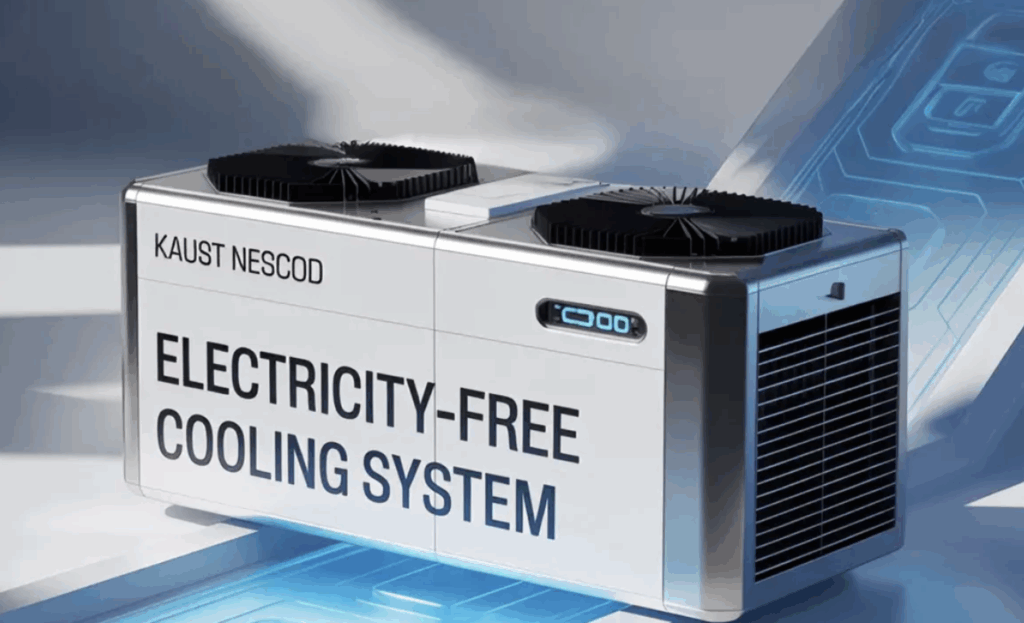
As heatwaves intensify globally and electricity bills continue rising, scientists are developing alternative cooling technologies that may reduce dependence on traditional air conditioners. One such innovation, called Nescod, is now drawing international attention because it can reportedly provide cooling without using continuous electricity.
Researchers say the system could become especially important for:
- Hot climate regions
- Rural areas with unstable electricity
- Low-income households
- Places facing extreme summer temperatures
What Is Nescod?
Nescod stands for:
No Electricity and Sustainable Cooling on Demand.
The system was reportedly developed by researchers led by Professor Peng Wang at King Abdullah University of Science and Technology (KAUST).
Unlike traditional ACs, the technology does not rely on:
- Compressors
- Refrigerant cycles
- Continuous electrical power
Instead, it uses a chemical cooling process involving:
- Ammonium nitrate
- Water
- Solar energy regeneration
How The Cooling System Works
The core principle behind the system is something called endothermic dissolution.
When ammonium nitrate dissolves in water:
- It absorbs heat from the surrounding environment
- The temperature around it drops significantly
Researchers say the system can reportedly reduce temperatures:
- From around 25°C to nearly 3.6°C
- In roughly 20 minutes during testing
After the cooling cycle ends, solar energy is used to regenerate the material so it can be reused again.
Why This Matters Now
Cooling demand is exploding worldwide.
Rising temperatures are increasing dependence on:
- Air conditioners
- Cooling appliances
- Refrigeration systems
This is placing enormous pressure on:
- Electricity grids
- Household budgets
- Carbon emissions
According to International Energy Agency projections cited in reports, India alone could have more than 1 billion AC units operating by 2050.
This creates major challenges involving:
- Power shortages
- Peak electricity demand
- Fossil fuel dependence
- Urban heat generation
Could It Replace Traditional Air Conditioners?
Not immediately.
Researchers and experts say systems like Nescod are still in early-stage development and may initially work better for:
- Small cooling applications
- Emergency cooling
- Food preservation
- Medicine storage
- Rural cooling systems
Traditional ACs still offer:
- Faster large-room cooling
- Better humidity control
- Continuous temperature management
However, electricity-free cooling could become an important supplemental solution in extreme climates and low-power regions.
Why Millions Are Interested In Alternatives
Traditional air conditioners come with several growing problems:
- High electricity bills
- Rising AC costs
- Grid overload during heatwaves
- Environmental impact
- Urban heat amplification
This is increasing global interest in:
- Passive cooling
- Terracotta cooling systems
- Reflective coatings
- Evaporative cooling
- Electricity-free technologies
In countries like India, many homes are already experimenting with:
- Clay-based cooling
- Natural ventilation
- Passive architecture
- Low-energy air coolers
Potential Benefits Of Electricity-Free Cooling
If scalable, systems like Nescod could offer several advantages:
- Lower electricity consumption
- Reduced carbon emissions
- Cooling access in off-grid regions
- Lower operating costs
- Reduced dependence on expensive AC systems
This could become especially important for regions facing:
- Extreme heatwaves
- Weak electricity infrastructure
- Energy shortages
- Climate-change-driven temperature increases
Challenges Still Remain
Despite the excitement, experts say several challenges remain before widespread adoption:
- Large-scale deployment
- Cooling duration limits
- Commercial manufacturing
- Material regeneration efficiency
- Safety and maintenance standards
Researchers are still working on improving:
- Scalability
- Efficiency
- Long-term reuse cycles
- Cost optimization
Cooling Technology Is Rapidly Evolving
The growing interest in electricity-free cooling reflects a larger global shift toward sustainable climate technologies.
Scientists and companies worldwide are now developing:
- Solar-powered cooling
- Passive cooling buildings
- Reflective cooling paints
- AI-controlled energy-efficient cooling
- Waterless cooling systems
As summers become hotter and energy demand keeps rising, cooling may become one of the world’s biggest infrastructure and sustainability challenges over the next two decades.