India’s proposed Delhi-Varanasi High-Speed Rail Corridor has received a significant boost with plans to add new stations in Agra and Mathura, improving connectivity for key industrial and urban clusters in western Uttar Pradesh. The project is expected to strengthen links between the National Capital Region (NCR), the Yamuna Expressway Industrial Development Authority (YEIDA) region, and major economic hubs along the corridor. The new stations are also expected to accelerate industrial development, tourism, logistics, and real-estate growth in the region.
The corridor is among India’s most ambitious high-speed rail projects and is expected to become the country’s second bullet train route after the Mumbai-Ahmedabad High-Speed Rail project.
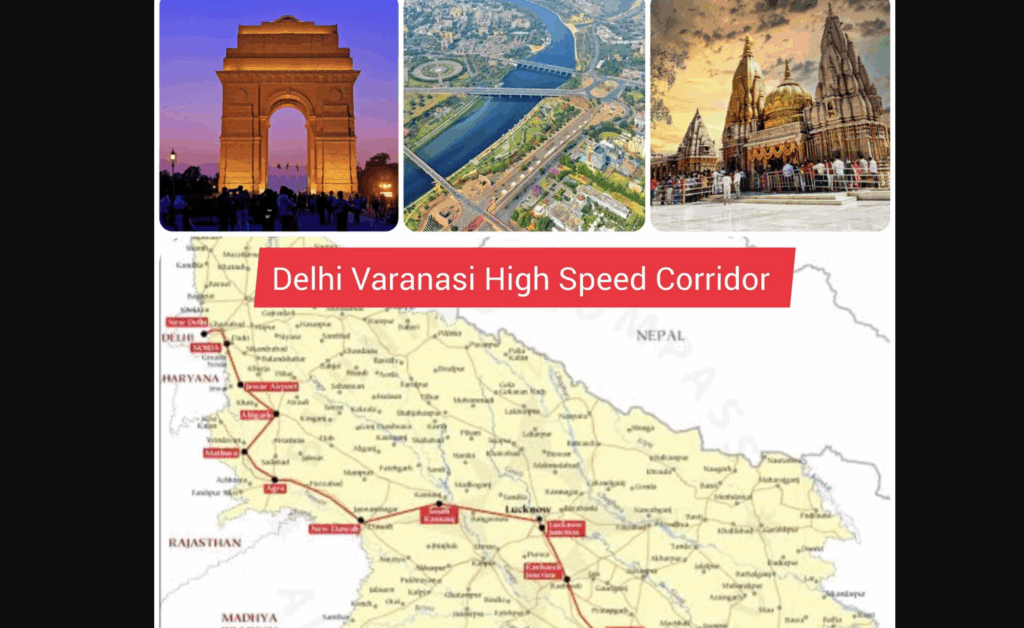
New Stations Planned In Agra And Mathura
According to reports, the National High-Speed Rail Corporation Limited (NHSRCL) is planning additional stations near Agra and Mathura to improve accessibility to rapidly growing industrial townships being developed along the Yamuna Expressway.
The stations are expected to serve not only local populations but also industrial zones, manufacturing clusters, logistics parks, and future urban developments being promoted by YEIDA.
Officials believe these additions will help integrate emerging economic centers with Delhi and eastern Uttar Pradesh through ultra-fast transportation.
Connecting The Yamuna Expressway Growth Corridor
One of the primary objectives of the project is to improve connectivity to the rapidly expanding Yamuna Expressway region.
The area has witnessed major investments in recent years, including:
- Noida International Airport (Jewar Airport)
- Electronics manufacturing clusters
- Semiconductor and technology parks
- Logistics hubs
- Data centers
- Industrial townships
High-speed rail connectivity could significantly improve mobility for professionals, businesses, and investors operating across these regions.
Urban planners believe bullet train connectivity may further increase the attractiveness of the Yamuna Expressway corridor as a destination for large-scale industrial investments.
Travel Time Could Drop Dramatically
The Delhi-Varanasi High-Speed Rail Corridor is expected to cover approximately 800 kilometers and allow trains to operate at speeds of up to 350 kmph.
Current travel times between Delhi and Varanasi range from 10 to 14 hours by conventional rail. The bullet train project is expected to reduce this journey to around four hours, transforming connectivity across northern India.
Cities expected to benefit include:
- Delhi
- Noida
- Mathura
- Agra
- Lucknow
- Prayagraj
- Varanasi
The corridor could also support future connectivity extensions toward Patna and other eastern Indian cities.
Economic Benefits Beyond Transportation
Experts believe the impact of the project will extend far beyond passenger transportation.
Historically, high-speed rail corridors have contributed to:
- Higher land values
- Increased commercial development
- Industrial expansion
- Tourism growth
- Job creation
Agra and Mathura are particularly important because of their tourism potential. Faster connectivity from Delhi could attract more domestic and international visitors to destinations such as the Taj Mahal and religious centers in Mathura and Vrindavan.
At the same time, industrial regions along the Yamuna Expressway may benefit from easier access to skilled talent, business travelers, and supply-chain networks.
Part Of India’s High-Speed Rail Vision
The Delhi-Varanasi corridor forms a key component of India’s broader high-speed rail strategy. The government has identified several potential bullet train routes across the country to improve inter-city connectivity and support long-term economic growth.
While land acquisition, detailed engineering studies, and project approvals are still progressing, the addition of Agra and Mathura stations indicates that planners are increasingly focusing on maximizing economic impact alongside transportation efficiency.
If implemented as planned, the corridor could reshape travel patterns across North India and create a new growth axis connecting major population centers, industrial zones, and tourism destinations.
Summary
The proposed Delhi-Varanasi Bullet Train Corridor is expected to include new stations in Agra and Mathura, improving connectivity for industrial townships along the Yamuna Expressway and key tourism destinations. The high-speed rail project aims to cut travel time between Delhi and Varanasi to around four hours while supporting industrial growth, real-estate development, logistics, and investment in one of North India’s fastest-growing economic corridors.