The global AI boom has created a historic financial milestone: NVIDIA is now valued higher than the combined market capitalization of all listed companies in India. According to multiple market reports, NVIDIA’s valuation recently crossed nearly $5.05 trillion, while India’s total equity market capitalization hovered around $5 trillion.
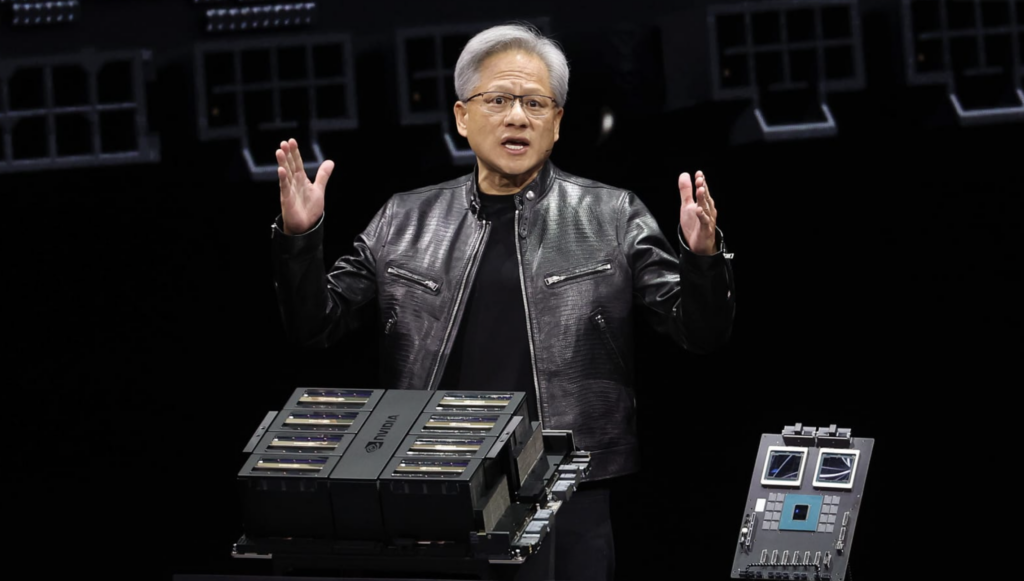
The comparison is extraordinary because India is currently the world’s fifth-largest equity market, home to thousands of companies across banking, energy, IT, manufacturing, telecom, infrastructure, and consumer sectors. Yet a single US technology company has now overtaken the entire ecosystem in market value.
The AI Revolution Created This Explosion
Just five years ago, NVIDIA was mainly known for gaming graphics cards. Today, it has become the backbone of the global AI economy.
Its GPUs power:
- ChatGPT and generative AI models
- AI data centers
- Autonomous systems
- Cloud computing infrastructure
- Enterprise AI deployments
Analysts estimate NVIDIA controls nearly 80% of the advanced AI accelerator market globally.
As companies rushed to build AI infrastructure, demand for NVIDIA’s chips exploded. Investors now view the company less as a semiconductor maker and more as the “infrastructure layer” of artificial intelligence.
NVIDIA’s Rise Has Been Unprecedented
The scale of growth is almost unimaginable:
- NVIDIA’s valuation was around $370 billion five years ago
- It has now crossed $5 trillion
- The company briefly even touched $5.5 trillion intraday this week
That means NVIDIA added more than $4.5 trillion in market value in just a few years — one of the fastest wealth creations in corporate history.
Its stock has surged because hyperscalers like:
- Microsoft
- Amazon
- Meta
…are collectively spending hundreds of billions of dollars on AI infrastructure.
Why India’s Market Is Under Pressure
The comparison also reflects recent weakness in Indian equities.
India’s market capitalization had earlier peaked near $5.7 trillion in 2024 before declining amid:
- Foreign investor outflows
- Rising crude oil prices
- Global geopolitical tensions
- Slower earnings growth in some sectors
At the same time, global investors aggressively shifted capital toward AI-linked US technology stocks, especially semiconductor and cloud companies.
Christopher Wood of Jefferies reportedly described India as a “reverse AI trade” because global AI enthusiasm diverted money away from emerging markets.
Global Markets Are Becoming Extremely Concentrated
NVIDIA’s rise also reveals a bigger trend:
Global stock markets are increasingly dominated by a handful of technology giants.
Reuters recently reported that the “Magnificent Seven” US tech companies now account for nearly one-third of America’s stock market value.
Technology’s dominance has become so extreme that:
- The US tech sector alone exceeds $23 trillion in value
- Tech-linked companies now drive almost half of the S&P 500’s movement
This concentration worries some analysts because global markets are becoming heavily dependent on AI optimism continuing indefinitely.
Why This Matters Beyond Stocks
The NVIDIA-vs-India comparison is symbolic — but powerful.
It shows:
- How AI has become the defining economic theme of this decade
- How capital is concentrating around AI infrastructure providers
- How semiconductor power is becoming geopolitical power
- How one company can dominate an entire technological revolution
For India, the moment is also a wake-up call.
India remains a global IT and software powerhouse, but the next wave of wealth creation may increasingly come from:
- AI infrastructure
- Semiconductor manufacturing
- Deep-tech innovation
- GPU ecosystems
- Advanced computing hardware
The bigger question now is:
Can India build its own globally dominant AI and semiconductor giants — or will the next decade’s biggest value creation remain concentrated in a handful of American tech firms?