South Korea’s stock market has witnessed one of its sharpest corrections in history, with an estimated $2.18 trillion in market value erased as investors rushed to sell AI-related stocks. The dramatic decline comes after months of extraordinary gains driven by enthusiasm surrounding artificial intelligence, semiconductor companies and retail investor participation.
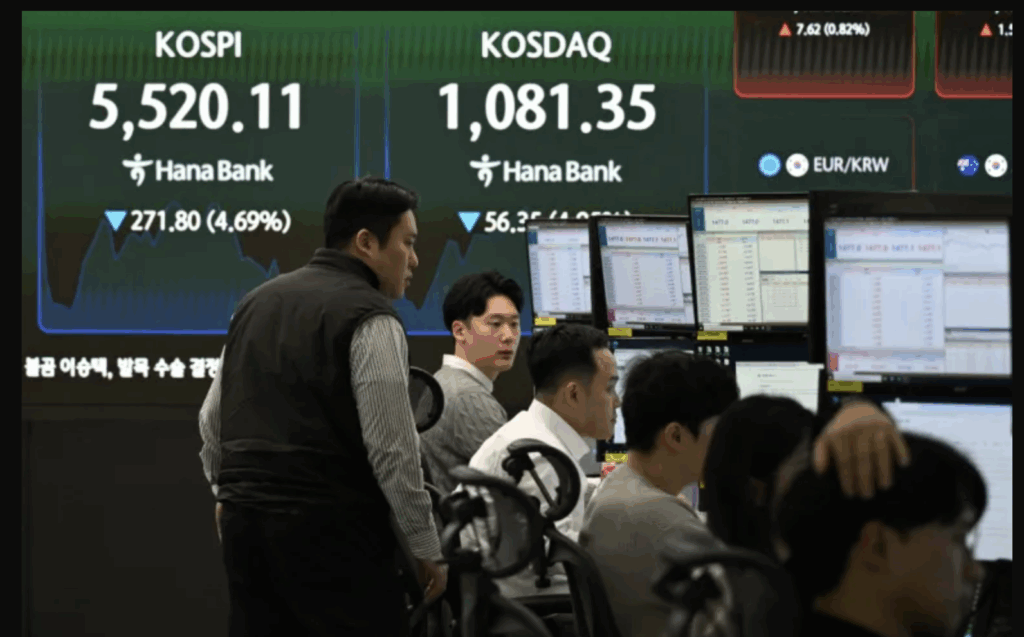
The selloff has raised fresh questions about whether the AI investment boom has entered a cooling phase or is simply undergoing a healthy market correction.
AI Rally Turns Into Massive Selloff
The benchmark KOSPI index suffered back-to-back heavy declines, falling as much as 12.6% during one trading session before recovering slightly to close lower. The plunge followed an almost 11% decline in the previous session, making it one of the steepest two-day declines in the market’s history.
The correction followed months of rapid gains fuelled by expectations of booming demand for AI chips and infrastructure.
Chip Giants Lead The Decline
South Korea’s biggest semiconductor companies were among the worst hit.
SK Hynix and Samsung Electronics, which together account for more than half of the KOSPI’s market capitalisation, saw their shares tumble sharply. Ironically, the selloff continued even after SK Hynix reported a nearly six-fold increase in profits, as investors believed the strong results still failed to justify extremely high market expectations.
The weakness also spread to semiconductor companies across Taiwan, Japan and other Asian markets.
What Triggered The Crash?
Several factors combined to trigger the sharp correction.
Investors have become increasingly concerned that global spending on AI infrastructure may not continue growing at the extraordinary pace witnessed over the past two years. At the same time, rapid advances by Chinese semiconductor companies have intensified fears of stronger competition in the global chip market.
Many retail investors had also used leveraged exchange-traded funds (ETFs) and borrowed money to increase their exposure to AI stocks. As prices fell, forced selling by brokers accelerated the market decline.
Government Considers Market Measures
South Korea’s government and financial regulators are closely monitoring the situation.
Finance Minister Koo Yun-cheol has apologised for the market volatility and said authorities are reviewing measures to improve market stability. Proposed reforms include tighter regulations on highly leveraged investment products and stricter rules for single-stock leveraged ETFs to reduce excessive speculation.
Officials are also evaluating additional stabilisation measures if market volatility continues.
AI Story Remains Intact
Despite the dramatic correction, analysts believe the long-term outlook for artificial intelligence remains positive.
The recent selloff reflects concerns over stock valuations and investor positioning rather than a collapse in demand for AI technologies. Companies worldwide continue to invest heavily in AI infrastructure, cloud computing and advanced semiconductors, although investors are becoming more selective about valuations and future earnings potential.
Interestingly, despite the recent crash, the KOSPI remains significantly higher for the year, highlighting just how strong the earlier AI-driven rally had been.
Summary
South Korea’s stock market has lost an estimated $2.18 trillion in value as the AI-driven rally reversed sharply, with the KOSPI suffering one of its biggest two-day declines on record. Heavy selling in Samsung Electronics and SK Hynix, concerns over AI spending, rising Chinese competition and leveraged retail investing all contributed to the correction, although analysts believe long-term demand for AI technologies remains strong.