In a landmark achievement for India’s healthcare and railway systems, a donor heart was transported for the first time on a Vande Bharat Express, covering nearly 250 kilometres in just two hours between Surat and Ahmedabad. The rapid movement of the organ helped doctors perform a life-saving heart transplant within the critical time window, despite heavy rain and challenging weather conditions.
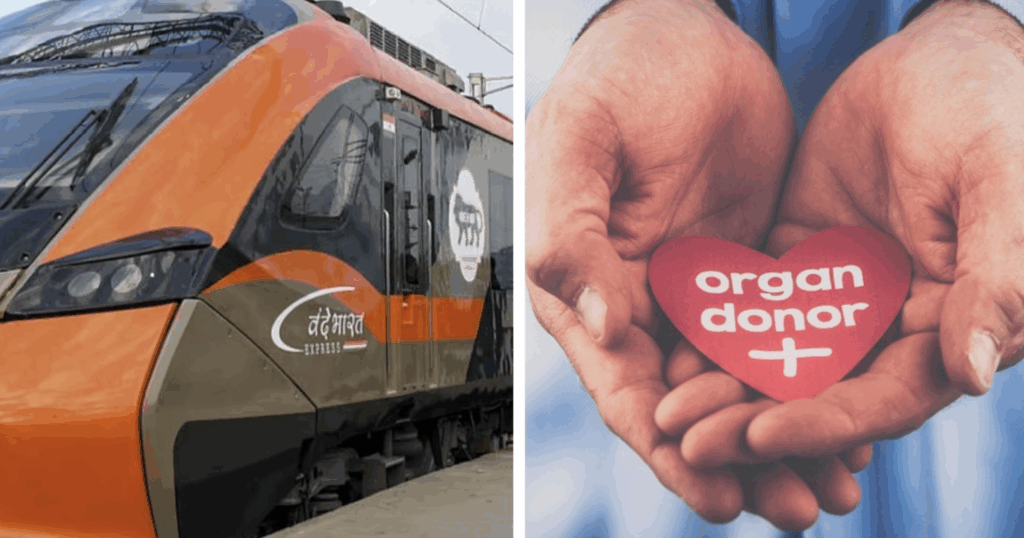
The operation demonstrated how high-speed rail can become an important part of emergency medical logistics in India.
Race Against Time
The donor heart was retrieved from a brain-dead donor at a hospital in Surat after the family consented to organ donation.
Since a human heart remains viable for transplantation only for a few hours after retrieval, every minute was crucial. Heavy rainfall made road transport uncertain, prompting authorities to use the Vande Bharat Express as the fastest and most reliable option to reach Ahmedabad.
The heart successfully completed the nearly 250-km journey in about two hours, allowing surgeons to proceed with the transplant on time.
Massive Coordination Made It Possible
The operation required seamless coordination between multiple agencies.
Doctors, transplant coordinators, railway officials, local police, ambulance services and station authorities worked together to ensure the organ moved without delay. Green corridors were created at both ends of the journey, allowing ambulances to quickly transport the heart between the hospitals and railway stations.
The coordinated effort ensured that the transplant timeline was not compromised despite adverse weather.
A First For Indian Railways
Medical teams and railway officials described the operation as the first successful transportation of a live donor heart using a train in India.
Until now, organs were primarily transported using ambulances, chartered flights or commercial aircraft. The success of this operation shows that high-speed trains can serve as an effective alternative, particularly when weather conditions disrupt air travel or road transport becomes difficult.
Boost For Organ Transplant Network
Experts believe this successful mission could open new possibilities for organ transportation across India.
As the Vande Bharat network expands, high-speed trains could become an important link in the country’s organ transplant ecosystem, especially for cities connected by fast rail corridors. Faster and more reliable transportation increases the chances of organs reaching recipients within the limited preservation window, ultimately helping save more lives.
The operation also highlights the importance of organ donation and the life-saving impact of timely coordination among hospitals, transport agencies and emergency responders.
Summary
India has successfully transported a donor heart by Vande Bharat Express for the first time, covering nearly 250 km between Surat and Ahmedabad in about two hours. Despite heavy rain, coordinated efforts by doctors, railway authorities, police and ambulance teams ensured the heart reached the recipient in time for a successful transplant, marking a major milestone in India’s organ transport capabilities.