




Infosys expects artificial intelligence services to become a major part of its business over the next two to three years, with AI-related work potentially accounting for almost half of the company’s total workload. Managing Director and CEO Salil Parekh made the prediction as demand for AI implementation, software development and enterprise automation continues to grow.
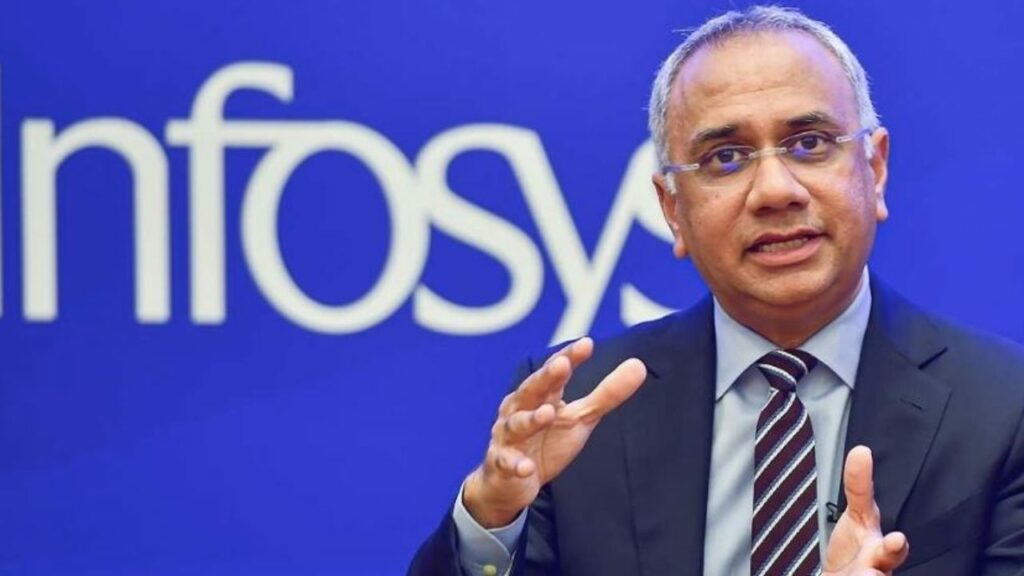
Speaking at the Bloomberg New Economy Forum 2026, Parekh said AI services already account for more than 8% of Infosys’ revenue and are expanding at a double-digit sequential growth rate.
AI Work Could Reach 20-30% Within Months
Parekh said AI services could account for 20-30% of Infosys’ work within the next few quarters if the current growth rate continues. Over two to three years, the share could approach 50%.
The company’s AI services include developing AI agents, using AI-powered coding tools, modernising legacy technology systems and helping businesses manage organisational change.
These services are becoming increasingly important as enterprises move beyond experimenting with AI chatbots and begin integrating the technology into their core business processes.
For Infosys, the opportunity lies in helping customers identify suitable AI applications, deploy them at scale and redesign workflows around the new technology.
Infosys Trains Thousands of Graduates in AI
Despite concerns that AI could reduce demand for traditional software jobs, Parekh described the technology as a positive development for Infosys and India’s IT services industry.
He said the company hired 20,000 college graduates in the previous financial year and plans to recruit another 20,000 during the current financial year.
New recruits receive AI training before working with clients to implement the technology and manage the changes associated with its adoption.
Parekh also revealed that approximately 80,000 of Infosys’ workforce of around 3 lakh employees are already working with coding tools on client assignments and internal projects.
The figures suggest that AI skills are becoming increasingly important across the company’s workforce, rather than remaining restricted to specialised research teams.
Businesses Are Looking for More Affordable AI Models
As enterprise adoption grows, customers are increasingly examining the cost of running AI applications.
Parekh said businesses are evaluating whether cheaper AI models, including open-weight alternatives, can deliver comparable results at lower costs.
The cost of AI inference, which refers to running trained models to generate responses or complete tasks, can become significant when applications operate at scale. Choosing a suitable model for each task could help companies manage expenditure without sacrificing necessary performance.
This trend may create opportunities for IT service providers to help customers select models, optimise infrastructure and integrate AI systems into existing enterprise environments.
Expensive Chips and Data Centres Pose Risks
Parekh also highlighted challenges associated with the rapid expansion of AI infrastructure. Semiconductor chips remain expensive, while data-centre development requires substantial investment in computing capacity, electricity and supporting infrastructure.
He warned that future advances in AI models could make inference several times cheaper, potentially changing the economics of existing data-centre investments.
Stricter data-sovereignty requirements could also constrain infrastructure expansion in certain markets. Parekh added that public resistance to large-scale AI infrastructure development, particularly in Western countries, could become another challenge.
Although demand is currently strong, he said some of these risks could become more visible over the next five to ten years.
What This Means for India’s IT Industry
Infosys’ outlook reflects a broader shift in the Indian IT services sector, where companies are increasingly positioning themselves as AI implementation and transformation partners.
The opportunity extends beyond building AI models. Businesses need support with data preparation, software integration, security, employee training and the redesign of existing processes.
However, the pace of adoption will depend on whether companies can demonstrate measurable returns on their AI investments while managing costs and operational risks.
Summary
Infosys CEO Salil Parekh expects AI services to account for nearly half of the company’s work within two to three years, up from more than 8% of revenue in the previous quarter. The company plans to hire 20,000 graduates this financial year and has around 80,000 employees working with coding tools. Parekh also highlighted risks from expensive chips, data-centre investment and changing AI economics.