Like a silent giant gliding across the seas, the future of cruising may soon hum not with engines, but with the quiet pulse of stored energy.
A Bold Leap Toward Cleaner Oceans
The global cruise industry could be approaching a turning point with the unveiling of Project Vision by Meyer Werft. Introduced at the Seatrade Cruise Global in Miami, this concept is being described as the world’s first fully battery-electric cruise ship, signaling a major shift in sustainable maritime travel.
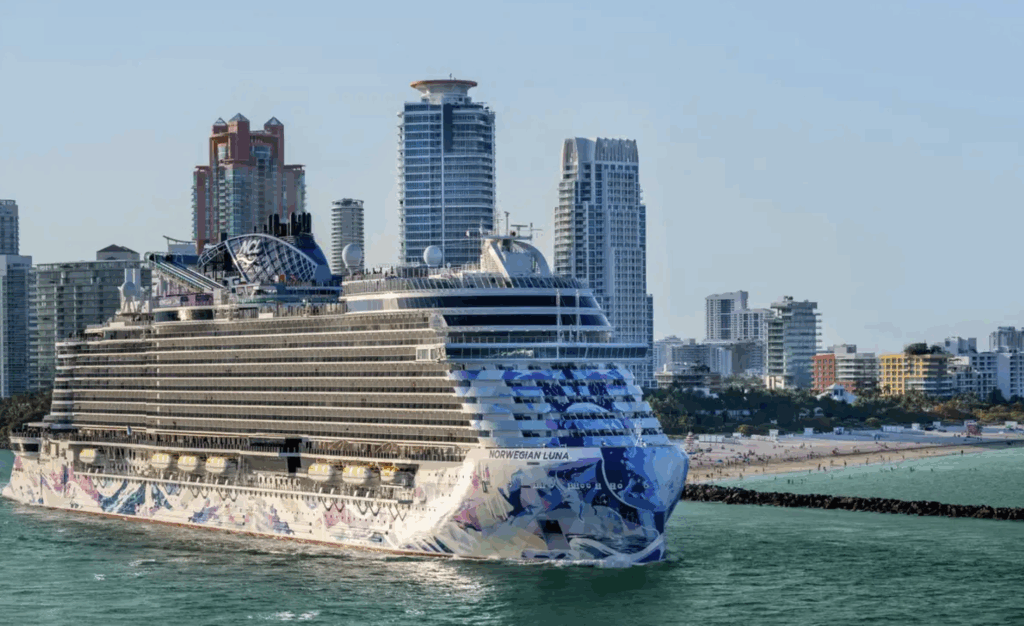
Stretching approximately 902 feet and weighing around 82,000 metric tonnes, the vessel is designed to host up to 1,856 passengers—making it significantly larger than most eco-friendly ship concepts. The initiative aims to build a comprehensive, zero-emission alternative without compromising on scale or luxury.
A key highlight is its potential to reduce greenhouse gas emissions by up to 95%. As Tim Krug stated, “We asked ourselves how we can use innovation to reduce CO₂ and contribute to decarbonization — not in 50 years, but much sooner. We enable a reduction in greenhouse gas emissions of up to 95%.” Unlike traditional cruise liners, the ship would rely entirely on battery power during standard operations, eliminating direct exhaust emissions and addressing long-standing environmental concerns tied to energy-intensive onboard amenities.
Redefining Scale, Comfort, and Sustainability
What truly distinguishes Project Vision is its scale and technological ambition. While concepts like Hurtigruten Sea Zero accommodate around 500 passengers using hybrid solutions, Project Vision pushes boundaries with a fully electric model at a much larger capacity. Its battery system, developed by Corvus Energy, reflects technology already proven in maritime use. As CEO Fredrik Witte noted, “Scaling to fully electric cruise ships shows the world that the technology is safe, mature, and ready to change the game.”
Expected to be operational by 2031, the ship will initially focus on European routes such as Barcelona to Civitavecchia, supported by expanding charging infrastructure across ports.
Beyond sustainability, the vessel promises a quieter and smoother onboard experience due to the absence of large engines. Design innovations include removing the traditional exhaust funnel, creating an open sun deck, and reimagining amenities like water parks as indoor, all-weather spaces.
Addressing criticism of pollution in port cities—highlighted by studies identifying Barcelona as heavily impacted—Project Vision aims to reshape the environmental narrative of cruising. As Johannes Bade said, “With battery electric cruise ships, we offer a competitive product that relies on existing technologies,” adding, “We are opening up entirely new opportunities for our customers to operate sustainably and profitably in the long term.”
If the oceans have long echoed with the roar of engines, Project Vision may mark the moment they begin to whisper a cleaner, quieter future.
Summary
Meyer Werft’s Project Vision, unveiled in Miami, is a fully battery-electric cruise ship designed for 1,856 passengers and expected by 2031. Promising up to 95% emissions reduction, it combines large-scale capacity with sustainability. Powered by advanced batteries, it aims to reduce pollution, enhance passenger comfort, and redefine cruising through quieter, cleaner, and more efficient maritime travel.