India’s crude oil sourcing pattern has undergone a major change as Venezuela has now become the country’s third-largest oil supplier in May 2026.
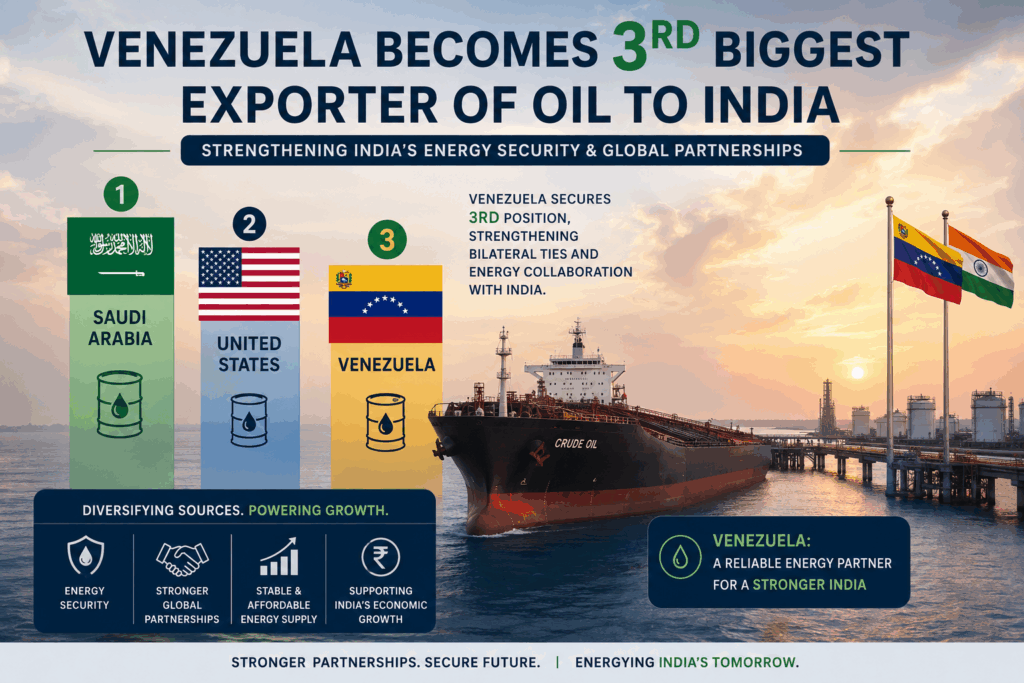
The development marks a significant shift in India’s energy strategy because Venezuela has overtaken traditional heavyweights like Saudi Arabia and the United States in crude exports to India.
According to reports, only Russia and the United Arab Emirates currently supply more crude oil to India than Venezuela.
The change comes at a time when global energy markets are facing intense uncertainty due to rising tensions in West Asia, concerns over disruptions in the Strait of Hormuz, and fluctuating crude oil prices worldwide.
Why India Is Buying More Venezuelan Oil
One of the biggest reasons behind the sudden rise in Venezuelan oil imports is pricing.
Indian refiners, including major private and public sector companies, are reportedly purchasing larger volumes of Venezuelan heavy crude because it is cheaper compared to several other global alternatives.
Heavy crude from Venezuela is particularly suitable for complex refineries like Reliance Industries’ Jamnagar refinery, one of the largest refining complexes in the world.
Industry experts believe Indian refiners are trying to secure stable and affordable supplies amid fears of supply disruptions from the Middle East.
The ongoing geopolitical tensions in West Asia and uncertainty surrounding shipping routes have forced countries like India to diversify their energy sourcing strategy more aggressively than before.
Strait Of Hormuz Crisis Triggering Global Concerns
The Strait of Hormuz remains one of the world’s most critical oil transit routes. A major portion of global crude oil shipments passes through this narrow waterway.
Any instability or disruption in the region immediately impacts oil prices and supply chains across the globe.
Recent geopolitical developments and military tensions involving Iran and the broader West Asian region have raised concerns over possible shipping disruptions, insurance costs, and delayed cargo movements.
As a result, many countries are now exploring alternative suppliers outside the Gulf region to reduce dependence on a single corridor.
India, being one of the world’s largest oil importers, is especially vulnerable to global crude supply disruptions.
India’s Top Crude Oil Suppliers In May 2026
| Rank | Country | Key Highlight |
|---|---|---|
| 1 | Russia | Continues to dominate Indian imports |
| 2 | UAE | Major Gulf supplier |
| 3 | Venezuela | Overtakes Saudi Arabia and US |
| 4 | Saudi Arabia | Declining share in recent months |
| 5 | United States | Lower imports compared to earlier levels |
The reshuffling reflects how rapidly global energy trade patterns are changing because of geopolitical tensions and economic considerations.
Venezuela’s Return To Global Oil Markets
Venezuela’s comeback in global oil exports is also linked to changing international policies and easing restrictions in certain markets.
For years, Venezuela faced severe sanctions and export restrictions that reduced its role in international energy markets. However, recent policy adjustments and growing global demand for affordable crude have helped Venezuelan exports rise again.
India appears to be taking advantage of this opportunity to strengthen energy security while keeping refining costs under control.
What This Means For India
Experts believe the shift toward Venezuelan oil highlights India’s increasingly flexible and pragmatic energy policy.
Instead of depending heavily on one region, Indian refiners are now sourcing crude from multiple countries based on pricing, availability, refinery compatibility, and geopolitical risk.
The move may also help India manage rising fuel price pressure domestically, especially as global crude markets remain volatile.
However, analysts warn that prolonged instability in global energy markets could continue affecting fuel prices, shipping costs, and import expenses in the coming months.
For now, Venezuela’s rise as a major supplier reflects how global geopolitics is rapidly reshaping India’s energy landscape.