Toyota has taken a major step towards next-generation sustainable transportation by filing a patent for a hydrogen-powered scooter inspired by the Suzuki Burgman platform. The development highlights how global automakers are now exploring hydrogen fuel-cell technology beyond cars and commercial vehicles, extending it to compact urban mobility solutions.
Toyota’s Hydrogen Scooter: What Is Special?
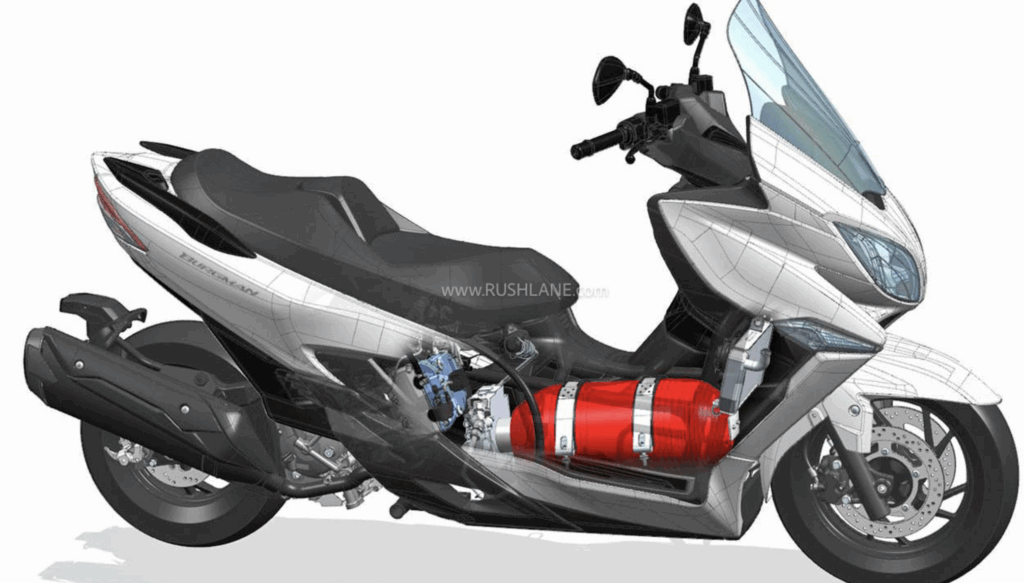
Unlike conventional electric scooters that rely on lithium-ion batteries, Toyota’s new concept uses hydrogen fuel-cell technology. The scooter reportedly features removable hydrogen canisters that can be swapped quickly instead of waiting for charging. This could drastically reduce refueling time and improve convenience for riders.
The patent design is based on an older Suzuki Burgman 400 prototype. Toyota and Suzuki are already part of the HySE (Hydrogen Small mobility & Engine) initiative, which focuses on developing hydrogen-powered small mobility solutions.
Swappable Hydrogen Tank System Explained
One of the most innovative aspects of the scooter is the removable hydrogen cylinder mechanism. According to the patent documents, Toyota has proposed two methods for removing the hydrogen canister:
- A hinged side-swing mechanism
- A scissor-linkage sliding mechanism
These systems are designed to make cylinder replacement safer, easier, and faster for users. The hydrogen tank is positioned around the floorboard area, similar to how removable battery packs are integrated into electric scooters.
Why Hydrogen Scooters Could Become Important
Hydrogen fuel-cell vehicles produce electricity through a chemical reaction between hydrogen and oxygen. The only major byproduct is water, making them a zero-emission mobility solution when green hydrogen is used.
Compared to electric scooters, hydrogen-powered scooters may offer:
- Faster refueling
- Lighter weight compared to heavy battery packs
- Longer riding range
- Reduced charging dependency
Some reports suggest the scooter could deliver around 200 km range on a full hydrogen cylinder.
Challenges Ahead For Hydrogen Two-Wheelers
Despite the excitement, hydrogen-powered two-wheelers still face major challenges. Hydrogen infrastructure remains limited globally, and producing clean hydrogen at scale is expensive. Initial vehicle costs are also expected to be higher than electric scooters.
However, Toyota’s patent indicates that hydrogen mobility is gradually moving closer to real-world adoption. With companies like TVS, Bajaj, and Suzuki also exploring hydrogen technology, the future of clean two-wheelers may extend beyond batteries alone.