Carmakers Respond to Growing Consumer Concerns
Leading automobile manufacturers Maruti Suzuki and Toyota Kirloskar Motor have sought to reassure vehicle owners that E20 petrol is safe for both older and newer vehicles. The clarification comes amid growing public concerns over the nationwide rollout of petrol blended with 20% ethanol and its potential impact on engine health, fuel systems, and long-term vehicle reliability. Industry executives stated that extensive testing and real-world data have shown no evidence of unusual wear and tear, corrosion, or component damage caused by E20 fuel.
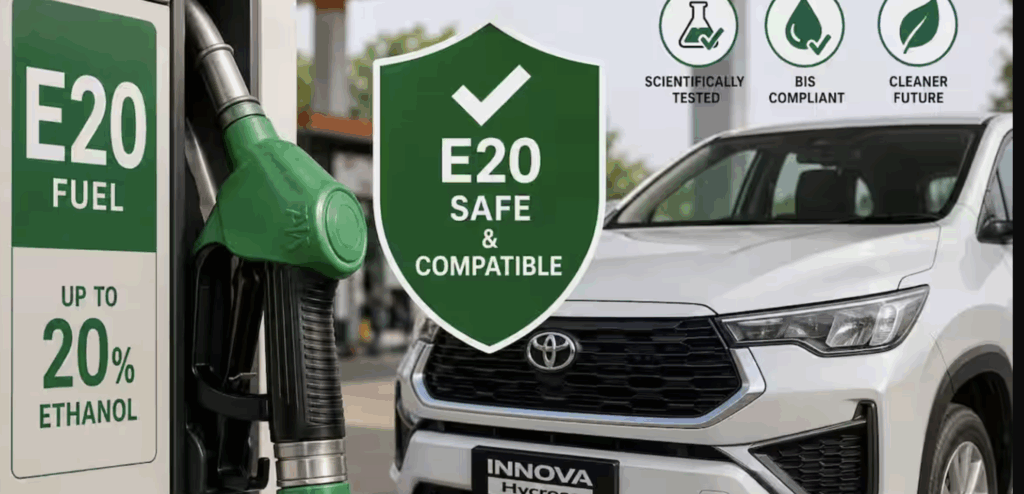
Maruti Suzuki’s Senior Executive Officer for Corporate Affairs, Rahul Bharti, said the company had tested vehicles originally designed for E10 fuel on E20 petrol across multiple parameters and found no issues of concern. He added that manufacturers had incorporated sufficient safety margins to ensure vehicle durability even when older vehicles use E20 fuel.
Evidence from Millions of Vehicles
One of the strongest arguments presented by the industry is the volume of real-world usage data now available. Maruti Suzuki reported that it had serviced more than 1.5 crore older-generation vehicles over the past two years and found no ethanol-related issues linked to E20 usage. Company officials emphasised that there has been no increase in cases involving corrosion, abnormal wear, or fuel-system failures attributable to the higher ethanol blend.
Toyota Kirloskar Motor executives echoed similar views, describing ethanol-blended fuel as a cleaner-burning alternative that contributes to India’s energy security while remaining safe for vehicles. According to industry representatives, years of testing have provided confidence that E20 can be used without causing significant damage to engines or fuel-system components.
The Mileage Trade-Off
While automakers defended the safety of E20 petrol, they acknowledged that there is a modest impact on fuel efficiency. Industry experts estimate that vehicles manufactured before 2023 may experience a mileage reduction of around 3% to 3.5% because ethanol contains less energy than conventional petrol. However, they stressed that the reduction is relatively small and does not affect vehicle reliability or safety.
Manufacturers also noted that ethanol’s higher octane rating can provide performance advantages, allowing future engine designs to achieve better combustion efficiency and improved performance characteristics.
Supporting India’s Ethanol Mission
India has aggressively expanded its ethanol blending programme to reduce crude oil imports, lower emissions, and improve energy security. The transition to E20 petrol represents one of the largest biofuel initiatives in the world. Industry leaders maintain that the programme has been implemented only after extensive scientific testing and validation across different vehicle categories.
As concerns continue to circulate among motorists, automakers are increasing outreach efforts to reassure customers that E20 fuel is safe for regular use. Their message is clear: while drivers may notice a slight drop in mileage, there is no evidence that E20 petrol causes engine damage, corrosion, or excessive wear in vehicles operating under normal conditions.