Indian Railways has significantly expanded the length of tracks capable of supporting train speeds of 130 kmph or more, with the network increasing nearly five-fold since 2014.
However, despite the major improvement in track infrastructure, overall train punctuality remains around 77%, highlighting the operational challenges that continue to affect railway services.
130 Kmph-Capable Tracks Rise To 24,173 Km
In 2014, only around 5,036 track km had a sectional speed potential of 130 kmph or above.
By August 2026, this figure had climbed to approximately 24,173 track km.
The increase means that the length of railway tracks capable of supporting speeds of at least 130 kmph has grown nearly five times in 12 years.
These faster sections now account for around 22.5% of the railway network.
More Than 80% Of Tracks Can Support 110 Kmph
The improvement is even more significant when tracks capable of speeds between 110 kmph and 130 kmph are included.
The length of tracks in this category increased from around 26,409 km in 2014 to approximately 62,036 km.
Together, tracks capable of supporting speeds of 110 kmph or higher now account for more than 80% of the network.
This provides Indian Railways with a substantially larger high-speed-capable network than it had a decade ago.
Track Upgrades Drive Higher Speeds
Indian Railways has undertaken extensive track renewal and modernisation work to improve speed potential.
Measures include the installation of heavier rails and improved switches, longer welded rail panels, better welding technology and mechanised maintenance.
Rail-grinding machines and modern track-monitoring systems are also being used to improve track condition.
Around 54,600 km of railway tracks were renewed between 2014 and February 2026.
Punctuality Remains A Challenge
Despite the infrastructure improvements, train punctuality has not increased at the same pace.
Overall punctuality stood at around 73.6% in 2023-24 before improving to 77.1% in 2024-25.
During 2025-26, punctuality reached approximately 77.2% up to February 2026.
Only a limited number of railway zones recorded punctuality above 90%.
Why Trains Still Face Delays
Higher track speed capability alone does not guarantee faster or more punctual train journeys.
Indian Railways operates around 25,000 trains every day, including passenger, suburban and freight services, with many trains sharing the same routes.
Congestion on busy corridors can therefore restrict train speeds even when the underlying track is capable of 130 kmph or more.
Maintenance blocks, fog, signalling constraints, alarm-chain pulling, cattle run-over incidents, agitations and other operational disruptions can also affect punctuality.
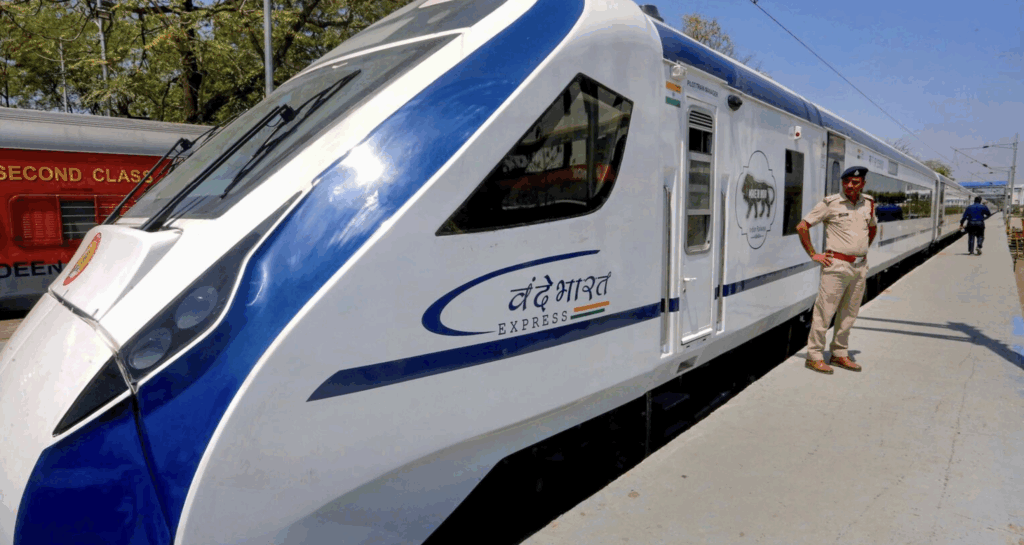
Vande Bharat Can Improve Average Speed
The introduction of Vande Bharat trains is also expected to improve average journey speeds.
These trainsets can accelerate and decelerate faster than conventional locomotive-hauled trains, allowing them to make better use of upgraded sections.
However, the maximum operating speed still depends on several factors, including track infrastructure, signalling, route conditions and safety requirements.
Bullet Train Network Will Be Different
India’s upcoming Mumbai-Ahmedabad bullet train project represents a different approach to high-speed rail.
Unlike conventional railway services that share tracks with multiple types of trains, the bullet train will operate on a dedicated high-speed corridor.
This allows the system to be designed specifically for much higher operating speeds.
Railways Targets Faster Journeys
The expansion of high-speed-capable tracks shows how Indian Railways has upgraded its infrastructure over the past 12 years.
The next challenge is making sure these improvements translate into faster and more reliable journeys for passengers.
With network capacity expansion, additional tracks, improved signalling and modern trains being introduced, the railways is attempting to increase average speeds while dealing with the enormous operational demands of one of the world’s largest railway networks.
Summary
Indian Railways has increased the length of tracks capable of supporting speeds of 130 kmph or more from 5,036 km in 2014 to 24,173 km in 2026, nearly a five-fold rise. More than 80% of the network can now support speeds of at least 110 kmph. However, overall punctuality remains around 77%, with congestion and operational constraints continuing to affect train timings.