China’s YouTube Rival Is Now Going After The World
Bilibili, often described as China’s answer to YouTube, is preparing for a major international expansion as it attempts to attract creators and viewers outside its home market.
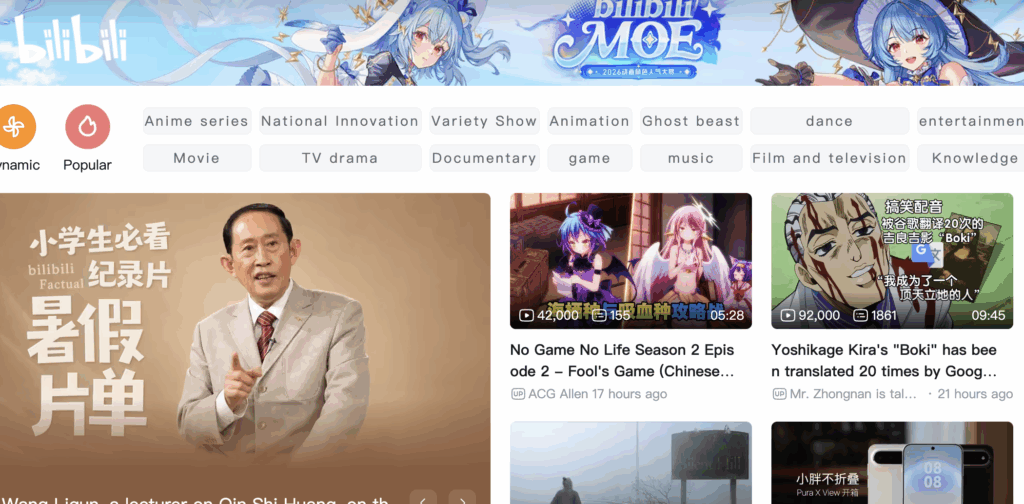
The 17-year-old video platform has relaunched its international app, is preparing an English-language website and is hiring employees across several major global markets.
The move marks a significant shift for Bilibili, which has historically been best known for its strong following among China’s younger internet users and its focus on anime, gaming, entertainment and creator-driven content.
Now, the company wants to compete directly for the attention of audiences and creators who already use platforms such as YouTube and TikTok.
Bilibili Is Relaunching Its International Platform
Bilibili had previously operated an international version of its platform but discontinued it last year.
The company has now relaunched the international app as part of its renewed global strategy.
One major change is that overseas users no longer appear to need passport or identity verification to sign up.
The company is also expected to bring its Chinese and international content ecosystems closer together, potentially allowing global audiences to discover a much larger library of Chinese content alongside videos created by international users.
An English Website Is Also Coming
Bilibili is reportedly developing an English-language version of its website.
This could be an important step because language has historically been one of the biggest barriers preventing international creators from using the platform.
An English interface could make it considerably easier for creators in the US, Europe and other markets to upload content, understand the platform and interact with audiences.
The company has also been promoting itself directly to international creators.
Bilibili Is Hiring Across The World
The company’s expansion is not limited to launching an app.
Bilibili is reportedly hiring community and other staff in cities including:
- Los Angeles
- London
- Mexico City
- São Paulo
- Istanbul
- Tokyo
The geographical spread is significant.
Instead of focusing on one overseas market, Bilibili appears to be building a broader international operation covering North America, Europe, Latin America and Asia.
The Company Wants Western Creators
The biggest challenge for Bilibili will not simply be attracting viewers.
It will need creators.
YouTube’s biggest advantage is its enormous creator ecosystem.
Millions of people already make money by uploading videos to YouTube, creating a continuous supply of new content that keeps audiences returning.
Bilibili is attempting to recreate at least part of that ecosystem by actively courting creators outside China.
MrBeast Has Already Shown The Potential
One of the clearest examples is MrBeast.
The hugely popular creator began publishing content on Bilibili in 2024 and attracted millions of views from Chinese audiences.
That demonstrated that international creators can potentially build substantial audiences on the platform.
Bilibili now appears to be asking whether the reverse can work as well.
Can Chinese technology and entertainment infrastructure attract Western creators who are already successful elsewhere?
Bilibili Says It Is Going Global
The company has openly signalled its intentions.
A Bilibili Creator Hub account recently stated that the platform is going global.
That public messaging is significant because the company had previously maintained a much lower international profile.
The latest moves suggest that global expansion is no longer an experimental side project but a strategic priority.
Bilibili Already Has A Massive Audience
The company is not starting from zero.
Bilibili’s Chinese platform reportedly has around 376 million monthly active users.
That gives the company a huge existing audience and a substantial content library.
Its challenge is to transform that domestic scale into international relevance.
YouTube has spent decades building a global creator economy.
Bilibili will have to convince creators that joining another platform is worth the additional effort.
Money Could Be Bilibili’s Biggest Weapon
Bilibili could have one major advantage when approaching creators: monetisation.
The platform has several ways for creators to generate revenue.
One of its most distinctive features is danmu, a system that allows viewers to post real-time comments that scroll across videos.
These interactions can also be monetised.
Creators can additionally receive financial support directly from fans.
For creators frustrated with the economics or competition on existing platforms, another source of revenue could be attractive.
Bilibili Is Building A Creator Economy
The company is reportedly developing a marketplace that would connect international creators with brands for sponsored content.
That could become an important part of its expansion.
Creators do not simply need viewers.
They need ways to make money from those viewers.
If Bilibili can provide advertising, fan payments, sponsorships and other monetisation options, it could give creators a reason to upload content regularly rather than simply experiment with the platform.
The Platform Is Trying To Appeal To Gen Z
Bilibili is positioning itself heavily around younger audiences.
Its creator materials describe its audience as Gen Z-oriented, affluent and well educated.
That demographic is particularly valuable to advertisers.
It also overlaps heavily with the audiences that already consume YouTube, TikTok, Instagram and other creator platforms.
Bilibili therefore has a potentially attractive market to target.
Why The Timing Matters
The global creator economy is changing rapidly.
TikTok has demonstrated that a Chinese-origin platform can become a worldwide entertainment powerhouse.
Short-form video has transformed how people discover creators.
Microdramas are exploding internationally.
Chinese creators are increasingly reaching audiences outside China.
Bilibili appears to believe the conditions are now right for another Chinese entertainment platform to make a global push.
But YouTube Will Be A Very Difficult Target
Taking on YouTube is an enormous challenge.
YouTube has a deeply established creator ecosystem, sophisticated advertising infrastructure, enormous global reach and years of creator data.
Creators already know how to build audiences and earn money on the platform.
Convincing them to invest time in another platform will require a compelling reason.
Bilibili will need to offer either significantly better monetisation, access to new audiences or features that creators cannot easily find elsewhere.
TikTok Has Already Shown The Path
Bilibili’s strategy is not completely unprecedented.
TikTok began as the international version of China’s Douyin and eventually became one of the world’s most influential social-media platforms.
Its success demonstrated that Chinese-developed consumer technology can appeal to audiences far beyond China.
Bilibili may now be hoping to repeat that success with long-form and community-driven video.
However, the company’s strategy is considerably closer to YouTube than TikTok.
Bilibili Has A Unique Community Culture
One of Bilibili’s biggest strengths is its distinctive community.
The platform developed around animation, comics and gaming before expanding into broader entertainment.
Its danmu commenting system gives videos a highly interactive feel, with viewers effectively watching and commenting together in real time.
That culture could differentiate Bilibili from more conventional video platforms.
The challenge will be translating that culture for audiences who did not grow up with the platform.
AI Will Also Play A Role
Bilibili is reportedly developing AI-powered content moderation systems for its international operations.
That will become increasingly important as the platform grows.
A global video platform must deal with spam, misinformation, copyright violations, harassment, violent content and other forms of abuse.
AI-powered moderation could allow Bilibili to handle large volumes of content more efficiently.
But moderation policies will also become a sensitive issue as the company enters markets with very different regulatory expectations.
Global Expansion Could Bring Regulatory Scrutiny
Bilibili’s Chinese ownership is likely to attract attention in countries such as the United States.
TikTok’s experience demonstrates how quickly concerns around data security, national security and content moderation can become major political issues for Chinese-owned technology companies.
If Bilibili becomes a significant platform among American users, it could face similar questions.
The larger its international audience becomes, the more scrutiny the company is likely to receive.
Censorship Could Become Another Challenge
Content moderation could be even more complicated.
Bilibili operates within China’s regulatory environment, while Western markets have different expectations regarding freedom of expression and content restrictions.
A global platform will need to balance these competing requirements.
How Bilibili handles politically sensitive content, moderation decisions and user data could become a critical factor in determining whether it succeeds internationally.
China Wants More Global Internet Platforms
Bilibili’s expansion also fits into a broader trend.
Chinese technology companies have increasingly looked beyond China’s enormous domestic market.
TikTok became a global phenomenon.
RedNote gained international attention.
Chinese e-commerce platforms have expanded aggressively into overseas markets.
Bilibili now appears ready to join that group.
The Bigger Battle Is For Creators
The next phase of the online video war may not simply be about who has the most viewers.
It may be about who controls the creators.
YouTube, TikTok, Instagram and other platforms are all competing for the same pool of influential personalities.
Creators attract audiences.
Audiences attract advertisers.
Advertisers generate revenue.
That creates a powerful cycle.
Bilibili is attempting to enter that cycle by offering creators another place to build audiences and earn money.
Could Bilibili Become A Serious YouTube Competitor?
It is far too early to say.
Launching an international app is relatively easy.
Building a sustainable global creator ecosystem is much harder.
Bilibili will need millions of users to become regular viewers, creators to consistently upload content and advertisers to spend money on the platform.
It will also need to overcome regulatory and trust concerns associated with Chinese technology companies.
India Could Be An Interesting Market
India represents another potentially important opportunity.
The country has hundreds of millions of digital-video consumers and one of the world’s largest creator communities.
However, Bilibili’s international strategy does not currently appear to provide a clear timeline for an Indian expansion.
Its immediate focus seems to be building operations across markets such as the US, Europe, Japan and Latin America.
If the global strategy gains traction, India could eventually become an important market.
The Real Test Will Be Creator Adoption
Bilibili has the technology.
It has a massive domestic audience.
It has a distinctive product.
It has money and a growing international operation.
But none of those guarantees global success.
The deciding factor will be whether creators outside China actually start treating Bilibili as an important part of their content strategy.
If thousands of established creators begin uploading regularly, viewers are likely to follow.
If creators simply experiment with the platform and return to YouTube and TikTok, Bilibili’s global ambitions could struggle.
China’s YouTube Wants A Global Audience
Bilibili is now making a much more serious attempt to escape the boundaries of its domestic market.
With a relaunched international app, an English-language website in development, international hiring and a clear focus on attracting creators, the company is positioning itself as a potential new competitor in the global online-video market.
The road ahead will not be easy.
YouTube remains enormously powerful, TikTok dominates short-form video and creators have little incentive to abandon platforms where they already have large audiences.
But Bilibili has something valuable: a massive existing community, a distinctive product and the financial resources to experiment.
The next question is whether the rest of the world is ready to become part of Bilibili’s community.
Summary
Bilibili, China’s major video-sharing platform, is making a renewed push into international markets with a relaunched global app, an English-language website in development and hiring across cities including Los Angeles, London, Mexico City, São Paulo, Istanbul and Tokyo. The company is actively courting international creators and developing monetisation opportunities through fan support and brand partnerships. Bilibili already has around 376 million monthly active users in China and has attracted global attention through creators such as MrBeast. However, challenging YouTube and TikTok will require building a powerful international creator ecosystem while navigating major concerns around content moderation, censorship, data security and regulation.