Ambitious Underground Transit Network Proposed
Pune may soon get one of India’s largest urban underground transit corridors, with authorities proposing a 54-kilometre route that will connect major employment hubs such as Hinjawadi, Kharadi, Hadapsar, Shivajinagar, Swargate, and Pune Railway Station. The project is being explored as a long-term solution to the city’s worsening traffic congestion and rapidly growing commuter population.
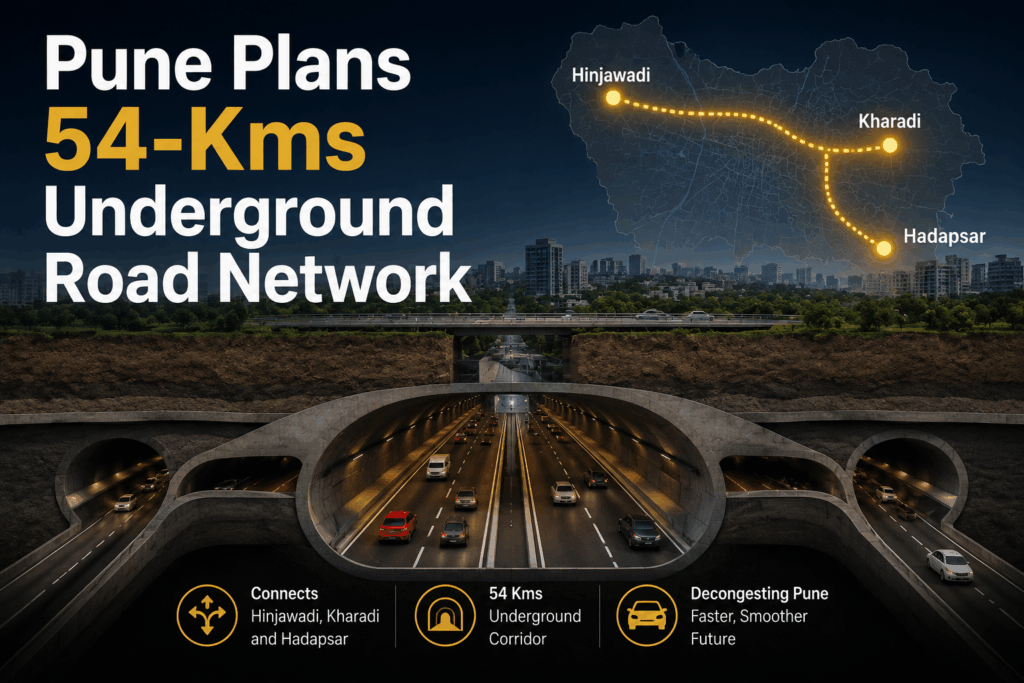
The proposed corridor is expected to serve thousands of daily commuters who currently spend hours navigating traffic between Pune’s key business and residential districts.
Connecting Pune’s Biggest Economic Zones
The planned route will link Pune’s most important commercial and IT centers. Hinjawadi houses the Rajiv Gandhi Infotech Park, while Kharadi has emerged as a major IT and financial services hub. Hadapsar continues to be a significant industrial and business district.
At present, traveling between these locations often requires crossing multiple congested corridors, resulting in long commute times. The underground network aims to create a seamless high-speed connection between these economic centers.
Designed to Ease Traffic Congestion
Pune’s vehicle population has grown rapidly over the past decade, placing enormous pressure on the city’s road infrastructure. Key stretches connecting Hinjawadi, Baner, University Circle, Shivajinagar, Kharadi, and Hadapsar frequently witness severe traffic jams, particularly during office hours.
Urban planners believe the underground corridor could encourage commuters to shift from private vehicles to mass transit, reducing road congestion, fuel consumption, and travel times.
Part of a Larger Mobility Vision
The proposed project is being studied alongside other major transportation initiatives already underway in Pune. Metro expansions, new road infrastructure, and multimodal transit systems are expected to work together to improve connectivity across the city.
Officials envision an integrated transport ecosystem where commuters can easily switch between metro lines, underground transit services, buses, and railway networks.
Benefits for the IT Workforce
A major objective of the project is to improve connectivity for Pune’s large IT workforce. Thousands of professionals commute daily between residential areas and business districts located in Hinjawadi, Kharadi, and Hadapsar.
Faster and more reliable transit options could significantly reduce travel stress, improve productivity, and support Pune’s continued growth as one of India’s leading technology hubs.
Feasibility Studies Underway
The corridor is currently in the planning and feasibility assessment stage. Authorities are evaluating technical requirements, project costs, ridership estimates, funding models, and environmental considerations before moving toward final approval.
If approved, the project would represent one of Pune’s most transformative transportation investments and could reshape urban mobility for decades.
Summary: Pune is exploring a 54-km underground transit corridor connecting Hinjawadi, Kharadi, Hadapsar, Shivajinagar, and other major hubs. The proposed project aims to reduce traffic congestion, improve connectivity for IT professionals, and support the city’s long-term growth. Currently under feasibility assessment, the corridor could become one of India’s largest underground urban transit networks if it receives final approval.