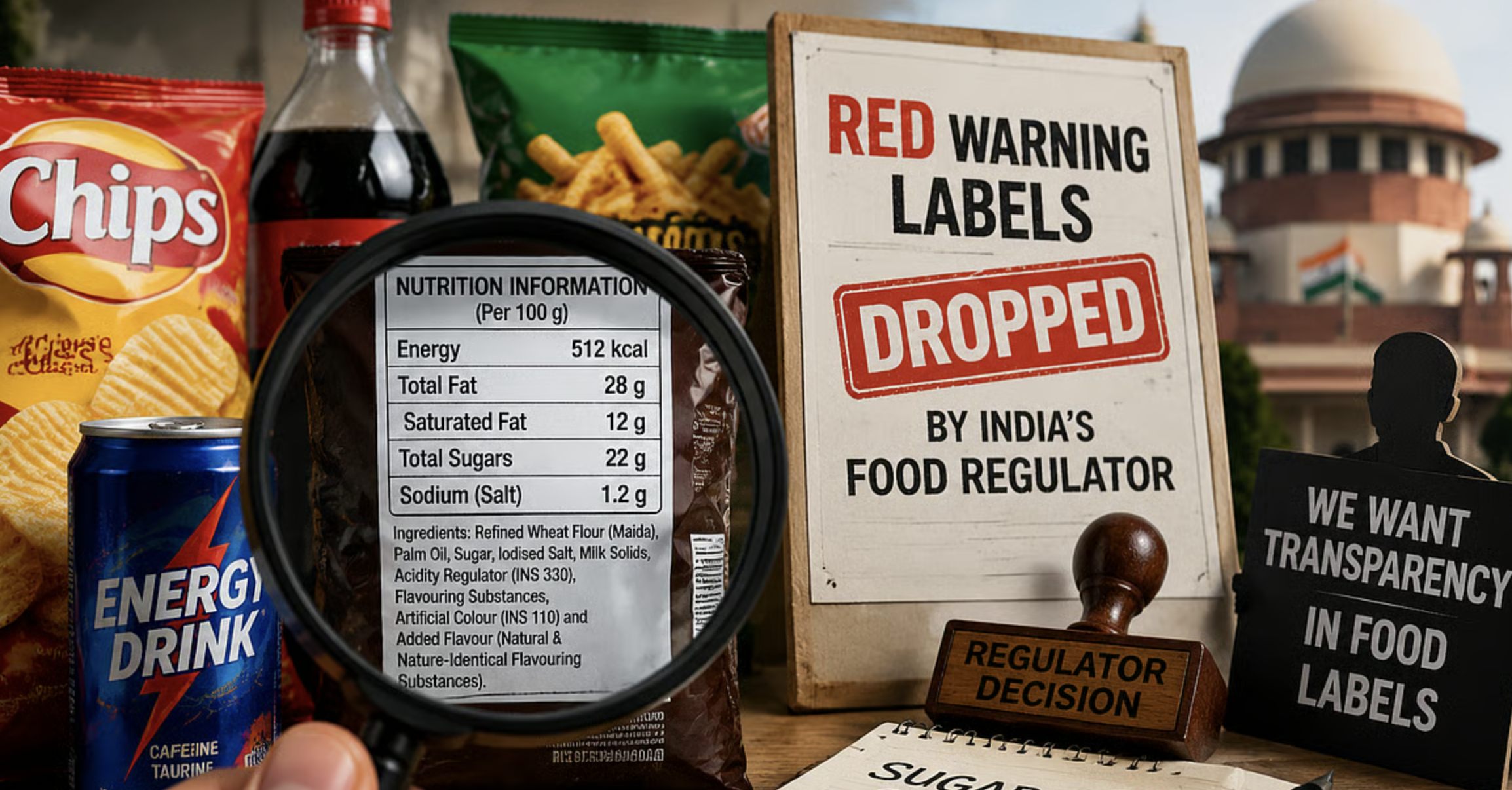


The Supreme Court of India has directed the Central Government and the Food Safety and Standards Authority of India (FSSAI) to introduce prominent warning labels on packaged food products containing excessive levels of sugar, salt and fat.
The apex court issued the directions on November 26, 2026, following a public interest litigation filed by 3S and Our Health Society.
A bench comprising Justices JB Pardiwala and K Vinod Chandran emphasised the importance of enabling consumers to make informed nutritional choices and protecting public health, particularly among children.
Separate Red Warning Labels For Sugar, Salt And Fat
Under the revised framework, packaged food manufacturers will be required to display individual red hexagonal warning symbols for nutrients exceeding prescribed limits.
The warning labels will carry standardised pictorial representations alongside the following declarations:
- HIGH FAT
- HIGH SUGAR
- HIGH SALT
Products exceeding permissible limits for all three nutrients will require three separate warning symbols instead of a combined label.
Each warning symbol should occupy at least 4% to 5% of the packaging’s principal display area, subject to justified exceptions.
FSSAI will also prescribe appropriate font sizes to ensure maximum visibility and readability.
Total Sugar And Saturated Fat To Be Considered
The Supreme Court has directed FSSAI to revise its methodology for determining whether packaged food products require warning labels.
Instead of calculating only added sugar and added fat, the regulator must consider total sugars, saturated fat and salt.
The court observed that existing nutrient thresholds under the Dietary Guidelines for Indians, 2024, cannot be adopted without appropriate revisions.
It also cautioned against excessively low thresholds, which could result in too many products carrying warnings and reduce their effectiveness.
Similarly, excessively high thresholds could undermine consumer protection by allowing products with unhealthy nutritional profiles to escape the labelling requirements.
FSSAI Gets Four Months To Finalise Regulations
The Supreme Court has granted FSSAI four months to finalise the draft regulations governing the new packaging requirements.
Food manufacturers are expected to receive a one-year compliance window following the finalisation of the regulations.
The revised framework could have significant implications for manufacturers of packaged snacks, confectionery, biscuits, soft drinks and other processed food products.
Companies may also consider reformulating their products to reduce sugar, saturated fat and salt content.
Schools To Promote Nutritional Awareness
The Supreme Court has additionally directed the Central Government to strengthen nutritional education among schoolchildren.
Apart from incorporating relevant changes into school curricula, authorities have been asked to organise workshops, interactive sessions and extracurricular activities promoting healthier food choices.
The new labelling framework aims to improve transparency and enable consumers to identify excessive nutrient levels without examining complicated nutritional information printed on the back of food packages.
Summary
The Supreme Court has directed FSSAI to introduce separate red hexagonal warning labels on packaged foods containing excessive sugar, saturated fat or salt. Each warning should occupy at least 4% to 5% of the principal packaging display area. FSSAI has four months to finalise draft regulations, while manufacturers are expected to receive a one-year compliance period.