Mumbai Gets A Major New Metro Corridor
The Maharashtra government has approved the ambitious Mumbai Metro Line 13, a ₹17,724.99 crore project that will connect Mira-Bhayandar with Vasai-Virar.
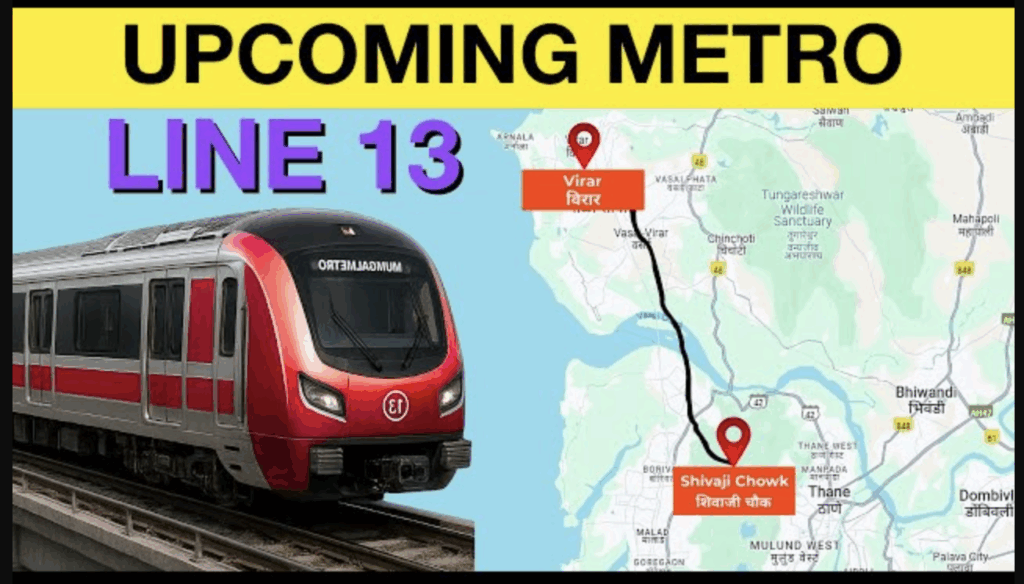
The 25.03-km corridor is expected to significantly improve public transport connectivity across the rapidly developing north-western parts of the Mumbai Metropolitan Region.
The project will be implemented by the Mumbai Metropolitan Region Development Authority (MMRDA).
25-Km Metro Line With 16 Stations
Metro Line 13 will stretch for around 25 km and feature 16 stations.
The corridor will include:
- 21.78 km of elevated track
- 3.25 km of underground track
- 13 elevated stations
- 3 underground stations
The combination of elevated and underground sections is intended to help the line navigate densely populated areas and existing infrastructure while keeping the overall corridor connected.
Mira-Bhayandar To Vasai-Virar Connectivity
The new Metro line is expected to provide a direct public transport connection between Mira-Bhayandar, Naigaon, Vasai, Nalasopara and Virar.
These areas have experienced rapid population growth and large-scale residential development over the past several years.
At present, commuters in these suburbs depend heavily on roads and suburban rail services. Metro Line 13 could provide another major transport option for daily travel.
4.49 Lakh Passengers Expected Every Day
The government expects Metro Line 13 to attract significant ridership once operational.
The corridor is projected to serve around 4.49 lakh passengers every day by 2031.
With thousands of people travelling between the northern suburbs every day for work, education and other purposes, the new Metro line could reduce pressure on both roads and existing suburban railway services.
Travel Time Could Fall By Nearly 50%
One of the biggest expected benefits is a reduction in travel time.
The new corridor is projected to reduce road travel time by nearly 50% between the connected areas.
For residents of Vasai-Virar and Mira-Bhayandar, where long daily commutes are common, the potential time savings could make Metro 13 particularly significant.
A Special Bridge Over Vasai Creek
One of the most notable engineering components of the project is a proposed 4.92-km road-cum-Metro bridge over Vasai Creek.
The structure will allow the Metro corridor to cross the creek while also improving road connectivity.
The bridge is expected to become one of the defining infrastructure elements of Metro Line 13.
Why Metro 13 Is Important For The Mumbai Region
The northern and north-western parts of the Mumbai Metropolitan Region have expanded rapidly, with large residential developments appearing far beyond Mumbai’s traditional suburban boundaries.
However, public transport infrastructure has not always expanded at the same pace.
Metro Line 13 could help address this gap by creating a dedicated rapid-transit corridor connecting several major suburban growth centres.
It could also improve connectivity with other Metro lines and transport networks as Mumbai’s larger Metro system expands.
Project Cost Has Increased Significantly
The Metro 13 project has undergone a substantial increase in its estimated cost.
The earlier proposal had been estimated at around ₹6,900 crore.
The revised project cost has now reached nearly ₹17,725 crore, reflecting changes to the alignment, underground construction and other infrastructure requirements.
The updated plan is intended to improve the project’s overall connectivity and integration with the wider Metro network.
Underground Section To Help Navigate Dense Areas
Around 3.25 km of the corridor will run underground.
Underground construction can be particularly useful in densely populated areas where acquiring land for an elevated corridor could be difficult or disruptive.
The underground section is therefore expected to help the project pass through congested areas while minimising surface-level disruption.
Five-Year Completion Target
The government has set a five-year target for completing Metro Line 13.
If construction progresses according to schedule, residents in the Mira-Bhayandar and Vasai-Virar regions could eventually have a significantly faster alternative to road travel.
However, projects of this scale involve complex construction, land, engineering and coordination requirements, meaning execution will be critical to meeting the target.
Real Estate Could Get A Boost
The Metro corridor could also have a major impact on property markets along its route.
Improved public transport generally increases the attractiveness of residential and commercial locations situated close to stations.
Areas that currently have relatively long travel times to major employment centres could become more appealing if Metro connectivity significantly improves.
This could encourage further residential and commercial development around future Metro stations.
A Major Expansion Of Mumbai’s Metro Network
Metro Line 13 is another major addition to Mumbai’s rapidly expanding Metro network.
The objective is not simply to connect two suburbs but to create stronger links between multiple growing urban centres across the Mumbai Metropolitan Region.
As more Metro corridors become operational, commuters could eventually be able to combine different lines to travel across the region without depending entirely on private vehicles or road-based public transport.
A ₹17,725 Crore Investment In Connectivity
The Maharashtra government’s approval marks a major milestone for the project.
With a 25-km route, 16 stations, underground sections and a major creek-crossing structure, Metro Line 13 will be one of the region’s significant upcoming transport projects.
If delivered on schedule, it could reduce travel times, ease pressure on roads and suburban trains, improve connectivity between Mira-Bhayandar and Vasai-Virar, and potentially accelerate development along the corridor.
For hundreds of thousands of future passengers, the biggest benefit could ultimately be simple: less time spent travelling every day.
Summary
The Maharashtra government has approved the ₹17,724.99 crore Mumbai Metro Line 13 connecting Mira-Bhayandar with Vasai-Virar. The 25.03-km corridor will have 16 stations, including 13 elevated and three underground stations, with 21.78 km of elevated track and 3.25 km underground. A 4.92-km road-cum-Metro bridge over Vasai Creek is also planned. The project has a five-year completion target and is expected to serve around 4.49 lakh passengers daily by 2031 while potentially reducing road travel time by nearly 50%.