A Major Milestone for Rail Freight
Indian Railways has achieved a major milestone in freight transportation by operating its first double-stack long-haul container train from Jawaharlal Nehru Port (JNPT) near Mumbai.
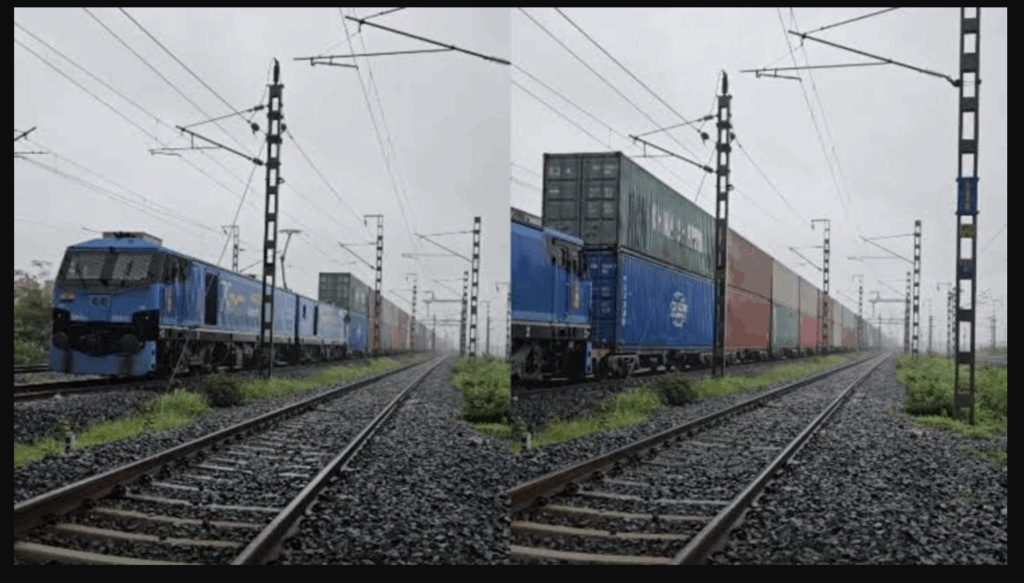
The train, which was approximately 1.3 kilometres long, carried 360 Twenty-foot Equivalent Units (TEUs) from JNPT to CONCOR’s Goods Cargo Terminal at Varnama in Gujarat’s Vadodara division. It covered around 422 kilometres in a single journey.
Train Carried 360 Containers in One Movement
The long-haul formation consisted of two double-stack container rakes coupled together.
Each rake carried 45+1 containers, with the leading rake hauled by locomotive 60311 and carrying 1,817 tonnes. The trailing rake was hauled by locomotive 24690 and carried 2,105 tonnes.
Together, the two rakes transported 360 TEUs in a single operation, demonstrating the ability of Indian Railways to move significantly larger volumes of containerised cargo through one train movement.
Journey Began From JNPT
The train departed JNPT at 7 pm on August 21, 2026, before travelling approximately 422 kilometres to the Varnama terminal in Vadodara division.
The operation was carried out on the Western Dedicated Freight Corridor (WDFC), which has been developed specifically to facilitate faster and more efficient freight movement across western India.
The successful run demonstrates how the freight corridor can support longer and higher-capacity container trains connecting major ports with inland terminals.
Why Double-Stack Trains Matter
Double-stack trains allow containers to be placed one above another, significantly increasing the amount of cargo that can be transported during a single journey.
When combined with a long-haul formation, the advantage becomes even greater. Instead of operating several separate trains to move the same volume of cargo, a larger quantity can be transported together.
This can help Indian Railways make better use of available railway capacity while reducing the number of train movements required for equivalent freight volumes.
Faster Container Evacuation From Ports
The development is particularly important for JNPT, one of India’s major container gateways.
Ports need to move imported and exported containers away from terminals quickly to prevent congestion and reduce the time containers remain at the port.
A higher-capacity rail service can help accelerate this evacuation process by moving more containers in fewer train movements.
Railway officials expect such operations to improve the utilisation of terminal infrastructure and available route capacity.
Potential To Reduce Freight Costs
Long-haul double-stack operations could also help lower the resources required to move large volumes of cargo.
Moving more containers in a single train can reduce the need for additional locomotive and container-flat-wagon movements. It can also potentially reduce freight transit times and improve overall logistics efficiency.
For businesses transporting large quantities of goods, improvements in rail freight efficiency could eventually contribute to lower transportation costs.
A Greener Alternative to Road Freight
The train was electrically hauled, adding an environmental advantage to the operation.
A single high-capacity container train can move cargo that would otherwise require a large number of trucks. Greater use of rail freight can therefore reduce dependence on diesel-powered road transportation, while also helping reduce road congestion and vehicle emissions.
This supports Indian Railways’ broader effort to shift more long-distance freight from roads to rail.
Western Dedicated Freight Corridor Gets Another Boost
The successful operation also highlights the growing importance of the Western Dedicated Freight Corridor in India’s logistics network.
The corridor connects important industrial and commercial centres with major ports, providing dedicated infrastructure for freight trains.
The ability to operate a 1.3-km-long double-stack formation demonstrates the potential for the corridor to handle larger freight volumes efficiently.
What It Means for India’s Logistics Network
India’s growing economy requires faster and more reliable movement of goods between ports, manufacturing centres, distribution hubs and markets.
Long-haul double-stack container trains can play an important role in meeting that demand by combining higher capacity with faster freight evacuation.
The JNPT-Varnama operation is therefore more than a one-off record. It demonstrates a freight model that could potentially be expanded as India’s dedicated freight-corridor network develops further.
A New Benchmark for Indian Rail Freight
The first double-stack long-haul container train marks an important step in the modernisation of India’s freight transportation system.
With 360 TEUs moved over 422 kilometres in a single operation, Indian Railways has demonstrated how longer trains, double-stacking and dedicated freight infrastructure can work together to increase cargo capacity.
As more such services are introduced, the approach could help India move larger volumes of goods while reducing pressure on roads, improving port connectivity and making rail-based logistics more efficient.
Summary
Indian Railways has operated its first 1.3-km double-stack long-haul container train from JNPT to Varnama in Gujarat. Carrying 360 TEUs over 422 kilometres, the electrically hauled train used the Western Dedicated Freight Corridor. The high-capacity operation can accelerate container evacuation, reduce train movements and freight costs, improve railway capacity utilisation and support a shift from road to greener rail-based freight transportation.