India has completed its 2,843-km Dedicated Freight Corridor network, marking a major milestone in the country’s railway and logistics infrastructure. With the final sections of the Western Dedicated Freight Corridor now operational, freight trains have a separate network designed to move goods faster while freeing up capacity on conventional railway routes.
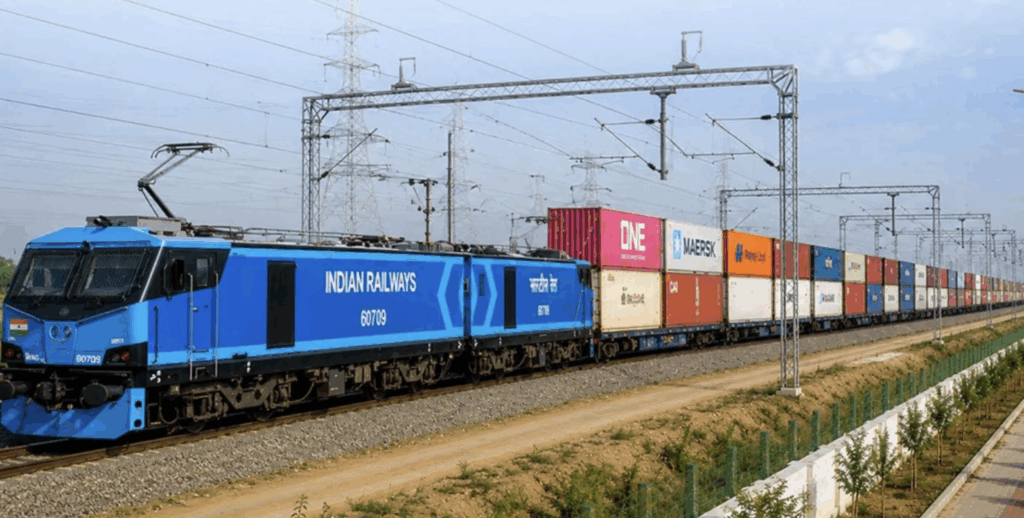
The completed network comprises the 1,506-km Western DFC connecting Dadri with Jawaharlal Nehru Port and the 1,337-km Eastern DFC connecting New Sahnewal in Punjab with New Sonnagar in Bihar.
Why India Needed Dedicated Freight Corridors
India’s railway network has traditionally carried both passenger and freight trains on the same routes. Some of the busiest routes, including the Howrah-Delhi and Mumbai-Delhi corridors, were operating at more than their designed capacity.
This created congestion, slower freight movement and competition between passenger and goods trains for available railway paths.
The DFC was designed to solve this problem by shifting a large portion of freight traffic onto dedicated tracks.
Freight Trains Can Now Travel Faster
One of the biggest changes is the improvement in freight train speeds.
Freight trains operating on the dedicated corridors can travel at average speeds of more than 50 kmph, around twice the average speed on many conventional routes.
The corridors can also accommodate heavier trains and double-stack container trains, allowing significantly more cargo to be transported in a single movement.
More than 400 freight trains are currently operating across the two corridors each day.
Passenger Trains Could Also Benefit
Although the DFC is primarily designed for freight, its impact could extend to railway passengers.
When goods trains move to dedicated tracks, capacity is released on existing railway lines. This gives Indian Railways additional room to operate passenger services and other freight trains.
It can also help reduce congestion and improve the reliability of train operations on heavily used routes.
Ports And Industrial Hubs Get Better Connectivity
The Western DFC is particularly important for connecting northern India’s industrial and manufacturing centres with major western ports.
Its direct connection to Jawaharlal Nehru Port provides an important route for containerised export and import cargo.
The Eastern DFC, meanwhile, serves important freight flows from India’s mineral-rich eastern region.
Better rail connectivity between industrial areas, logistics hubs and ports can make the movement of goods more predictable and potentially reduce supply-chain costs.
Could Freight Shift From Roads To Railways?
Another major objective is to increase the role of railways in India’s freight transportation.
Road transport currently handles a substantial portion of India’s cargo movement. A faster and more reliable freight railway network could encourage some long-distance cargo to shift from road to rail.
This could reduce pressure on highways while improving the efficiency of bulk and containerised freight transportation.
However, the full benefit will depend on factors such as first- and last-mile connectivity, freight terminals, pricing and integration with ports and logistics parks.
The Next Freight Corridor Is Already Being Planned
The completion of the Eastern and Western DFCs is not necessarily the end of India’s dedicated freight corridor expansion.
A new 2,052-km Dedicated Freight Corridor between Dankuni in West Bengal and Surat in Gujarat has been proposed. The planned corridor would pass through several major industrial and mineral-producing regions and connect with the existing Western DFC.
If developed, it could further expand India’s dedicated freight network and create another major east-west logistics route.
A New Phase For Indian Railways
The completion of the 2,843-km network changes the focus from simply building freight infrastructure to making the network work as efficiently as possible.
Better terminals, multimodal logistics parks, feeder routes and connections to ports will be important in determining how much economic value the DFC network ultimately creates.
For Indian Railways, the dedicated freight corridors represent more than new railway tracks. They create additional capacity, faster freight movement and the possibility of a more efficient national logistics system.
Summary
India has completed its 2,843-km Dedicated Freight Corridor network, comprising the Eastern and Western corridors. The dedicated tracks allow freight trains to move faster, including heavier and double-stack container trains, while freeing capacity on conventional railway lines. The network also strengthens links between industrial centres, logistics hubs and ports, with another major east-west corridor being planned.