Google is no longer treating Search as just a list of links.
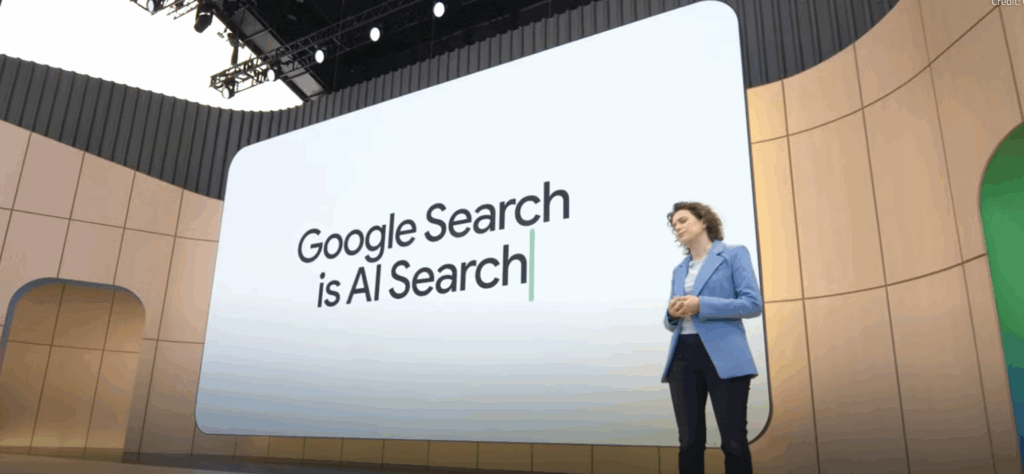
At Google I/O 2026, the company unveiled what may become the biggest transformation in Google Search since its launch — an AI-powered ecosystem where Gemini-based agents actively perform tasks, monitor information, and interact with apps on behalf of users.
At the center of this strategy is Gemini 3.5 Flash, Google’s latest AI model designed specifically for “agentic AI” — systems capable of reasoning through multi-step tasks instead of simply answering prompts.
Google executives now openly describe this shift as entering the “Agentic Gemini Era.”
What Gemini 3.5 Flash Actually Changes
Earlier Gemini Flash models mainly focused on speed. But Gemini 3.5 Flash is being positioned differently.
Google says the model is optimized for:
- Multi-step reasoning
- Long-duration workflows
- Autonomous task execution
- Coding and app generation
- Context-aware decision making
- Real-time conversational assistance
The model is now becoming the default intelligence layer across:
- Google Search AI Mode
- Android
- Chrome
- Gemini app
- Google Workspace
- Android Studio
- Google AI Studio
This means Google is no longer building isolated AI products — it is embedding Gemini into nearly every core Google service simultaneously.
Search Is Becoming More Like A Personal Assistant
The biggest shift is happening inside Google Search itself.
Google announced that Search AI Mode can now:
- Understand complex conversational queries
- Accept text, voice, image, video, and file inputs
- Retain conversational context
- Perform follow-up reasoning
- Monitor the web continuously
- Trigger AI agents for tasks like reservations or shopping
Instead of users manually searching multiple websites, AI agents may increasingly:
- Compare information automatically
- Watch for product drops
- Track price changes
- Monitor real-estate listings
- Fill forms
- Book reservations
- Generate summaries proactively
This represents a major departure from traditional keyword-based search.
The Backstory: Why Google Is Moving So Aggressively
Google’s urgency is closely tied to the rise of generative AI competitors like OpenAI and growing pressure from Apple’s upcoming AI ecosystem.
For decades, Google dominated internet discovery through traditional search. But conversational AI suddenly threatened that model by allowing users to ask questions directly instead of browsing web links.
That created a major existential risk for Google’s advertising and search business.
As a result, Google began integrating Gemini deeply into Search, Android, Chrome, and Workspace at an unprecedented pace.
The company also appears eager to establish Gemini as the operating intelligence layer for Android before Apple launches its next-generation AI-powered Siri ecosystem.
AI Agents Are Becoming Google’s Main Bet
A major theme across Google I/O 2026 was “AI agency.”
Instead of passive chatbots waiting for instructions, Google now wants AI systems capable of:
- Taking initiative
- Understanding intent
- Performing actions independently
- Collaborating across apps
- Managing workflows continuously
Google’s new Antigravity platform is reportedly designed to allow multiple sub-agents to collaborate on larger tasks automatically.
Meanwhile, Gemini Spark — Google’s next-generation AI assistant — is being rolled out as a proactive AI layer that works across Android and Google services.
This Could Completely Change How The Internet Works
The implications go far beyond Google products.
If AI agents increasingly summarize, compare, and interact with websites automatically, the traditional web ecosystem itself could change dramatically.
Several researchers have already warned that generative AI search may disrupt how websites receive traffic and visibility online.
Instead of users clicking through multiple pages, AI-generated answers may increasingly become the primary interface for information retrieval.
This creates major questions around:
- Publisher traffic
- SEO models
- Advertising economics
- Web monetization
- Information reliability
Android Is Becoming The AI Battleground
Google’s strategy also reflects how smartphones are entering a new phase of competition.
For years, companies competed mainly on:
- Cameras
- Displays
- Battery life
- Chip performance
Now, AI agents are becoming the next major battleground.
Google wants Gemini deeply integrated into Android before rivals fully establish competing AI ecosystems.
That is why Gemini is now expanding into:
- Smart glasses
- Android XR
- Cars
- Wearables
- Workspace
- Chrome
- YouTube
- Shopping systems
The Future Of Search May No Longer Look Like Search
The biggest takeaway from Google’s latest announcements is simple:
Google increasingly sees the future of Search not as a search engine — but as a proactive AI operating system for the internet.
And Gemini 3.5 Flash appears to be the first major step toward making that vision actually work at scale.