




Google’s Gemini 4 Argon and Anthropic’s Claude Opus 5.5 are competing for a place among the leading AI models for advanced coding, research and business automation. While both are designed to handle complex, multi-step tasks, their strengths differ across benchmarks, pricing, context handling and professional applications.
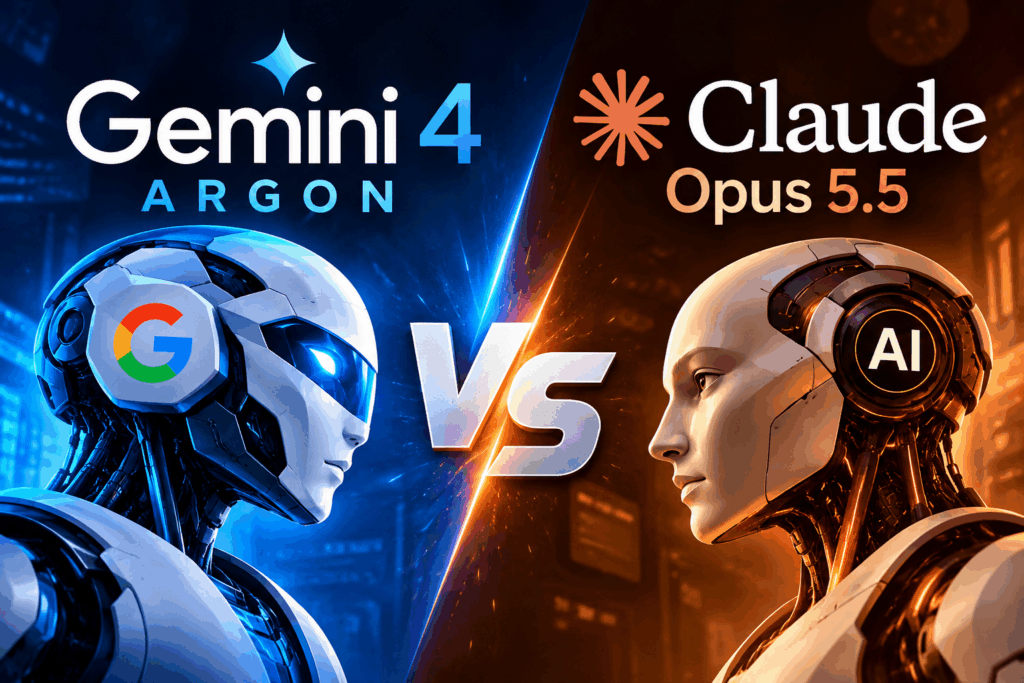
Gemini 4 Argon became generally available on October 13, 2026, while Claude Opus 5.5 launched earlier, on September 22. The comparison highlights how the choice between AI models increasingly depends on the task rather than a single overall ranking.
Gemini 4 Argon Leads in Several Knowledge and Automation Benchmarks
Google’s published benchmark results show Gemini 4 Argon ahead of Claude Opus 5.5 in several categories, including business automation, financial analysis, legal agent tasks and long-context reasoning.
On Google’s reported results, Argon scored 51.3% on AutomationBench, compared with 42.5% for Opus 5.5. In the Vals Finance Agent v2 evaluation, Argon scored 65.4%, against 58.6% for Anthropic’s model.
The difference was particularly large on Harvey’s Legal Agent Benchmark, where Argon recorded 19.6%, compared with 3.8% for Opus 5.5.
Argon also performed strongly on long-context tasks, including evaluations involving information spread across very large inputs. These capabilities could benefit professionals working with lengthy reports, complex document collections and large codebases.
However, these figures come from Google’s reported evaluation results. Benchmark outcomes can vary with testing methods, model configurations and task selection.
Claude Opus 5.5 Remains Competitive in Coding
Claude Opus 5.5 performs strongly on terminal-based software engineering and complex coding tasks.
In Google’s published comparison, Opus 5.5 scored 66.4% on Terminal-Bench 4.0, ahead of Argon’s 57.4%. It also led on FrontierSWE v2, scoring 62.3% against Argon’s 55%.
Opus also recorded higher results on PostTrainBench, an evaluation related to machine learning engineering.
These results make Opus 5.5 worth considering for developers who rely heavily on command-line tools, repository-level changes and complex software engineering workflows. Argon, meanwhile, showed strengths in other coding evaluations, including DeepSWE and Vibe Code Bench.
Neither model wins every coding task, so developers should test both against their actual repositories and development processes.
Pricing Advantage for Gemini 4 Argon Is Temporary
One of Argon’s major attractions is its introductory API pricing. Until November 30, 2026, Google charges $2 per million input tokens and $10 per million output tokens.
From December 1, the rates are scheduled to rise to $4 per million input tokens and $20 per million output tokens, matching the standard token rates for Claude Opus 5.5.
The headline token price does not tell the whole story. A model that uses more tokens or requires repeated attempts can cost more per completed task, even when its individual tokens are cheaper.
Businesses should therefore compare total task costs, including retries, output volume and human review, rather than relying solely on advertised API rates.
Context Windows and Long Outputs
Both models support context windows of approximately one million tokens, allowing them to process large amounts of information within a single interaction.
Gemini 4 Argon has an additional advantage for extremely long responses. With its long-decoding feature enabled, it can generate up to one million tokens in a single response. Claude Opus 5.5 has a standard maximum output of 128,000 tokens, with a higher limit available through a Batch API beta.
Argon may therefore be useful for very large document generation, extensive code migrations and workflows that require unusually long outputs. Its broader input support also includes audio and video, while Opus 5.5 supports text and images.
Which AI Model Should You Choose?
Gemini 4 Argon is worth evaluating for long-context analysis, document-heavy workflows, financial and legal agents, and complex automation. Its introductory pricing also makes it attractive for experimentation before the scheduled December increase.
Claude Opus 5.5 is a strong option for terminal-heavy coding, machine learning engineering and teams already using Anthropic’s development tools or supported cloud platforms.
The most reliable approach is to run both models on identical real-world tasks and compare accuracy, completion rates, token usage, response time and the amount of human correction required.
Summary
Gemini 4 Argon and Claude Opus 5.5 offer different strengths rather than a universal winner. Google’s reported benchmarks favour Argon in several knowledge-work and automation tasks, while Opus 5.5 leads in terminal-based coding and some software engineering evaluations. Argon’s introductory API pricing ends on November 30, 2026. Context needs, actual task costs and performance on real workloads should guide the choice.