In a significant push toward India’s electric mobility future, Hyundai Motor Company and TVS Motor Company have formalized a strategic partnership to develop and commercialize electric three-wheelers (E3Ws).
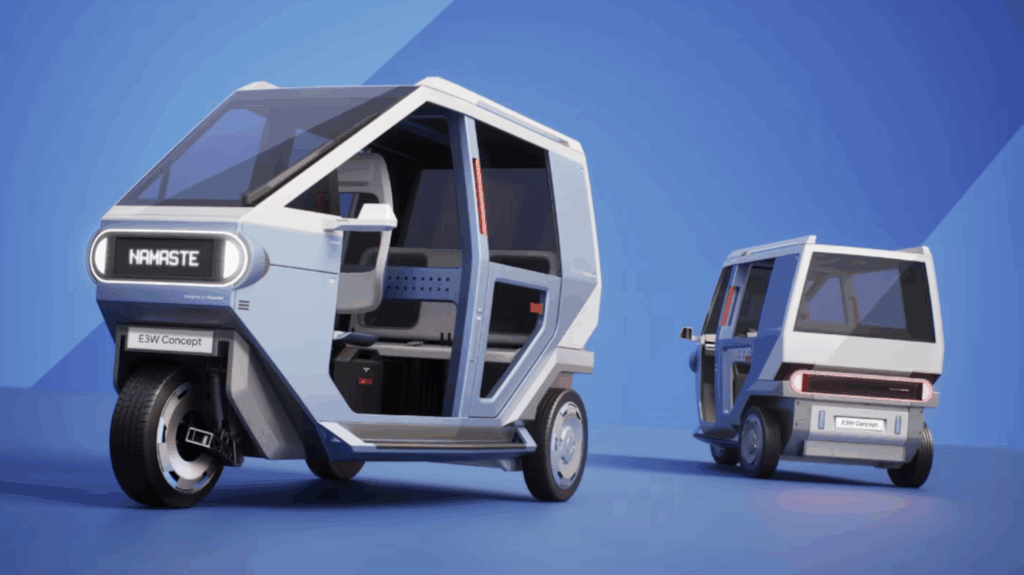
The collaboration, sealed through a Joint Development Agreement (JDA), marks Hyundai’s serious entry into India’s last-mile mobility segment—one of the fastest-growing EV markets in the country.
What the Hyundai–TVS Partnership Is About
The partnership focuses on creating purpose-built electric three-wheelers tailored specifically for Indian conditions.
These vehicles will cater to:
- Passenger transport (auto-rickshaws)
- Cargo and delivery services
- Emergency and utility use cases
The project builds on a concept first showcased at the Bharat Mobility Global Expo 2025 and now moves toward real-world production.
Who Will Do What?
The collaboration is structured to leverage the strengths of both companies:
- Hyundai Motor Company will lead design, innovation, and R&D, using its global expertise in electric mobility and human-centric engineering
- TVS Motor Company will handle manufacturing, engineering, and distribution, using its strong presence in India’s two- and three-wheeler market
This division ensures both global innovation and local execution—key for success in India.
Focus: Last-Mile Mobility Revolution
India is the world’s largest three-wheeler market, making it a crucial segment for electrification.
The partnership aims to address:
- Urban congestion
- Pollution from traditional auto-rickshaws
- Rising demand from delivery and logistics platforms
Electric three-wheelers are especially important in last-mile connectivity, powering everything from daily commutes to e-commerce deliveries.
Designed for Indian Conditions
Unlike generic EVs, these new vehicles will be custom-built for India, with features such as:
- Adaptability to rough roads and monsoon conditions
- Thermal management for hot climates
- Ergonomic design for long daily usage
- Flexible layouts for cargo and passengers
Localization of components will also help keep costs competitive.
Beyond India: Global Ambitions
While India is the primary focus, the partnership also has export potential.
The companies plan to expand into other emerging markets, where similar mobility challenges exist.
This positions India not just as a consumer market—but as a manufacturing hub for global EV solutions.
Why This Matters
This partnership signals a larger shift in India’s EV ecosystem:
- Global automakers entering micro-mobility
- Strong push toward electrifying public transport
- Growing demand from gig economy and logistics
- Increased focus on sustainable urban mobility
The Bigger Picture
The Hyundai–TVS collaboration is more than just a product launch—it’s a strategic move to reshape urban transportation.
If executed well, these electric three-wheelers could become the backbone of India’s clean mobility revolution—quietly replacing millions of fuel-powered autos on the streets.