

Anthropic, the company behind the Claude AI assistant, has acquired Mithril Medicine, a biotechnology startup founded and operated by a single full-time employee. The acquisition marks a significant step in Anthropic’s efforts to use artificial intelligence to accelerate drug discovery and develop treatments for rare diseases.
The company disclosed the acquisition on October 27, 2026, revealing that Mithril had been working on treatments for two rare forms of muscular dystrophy. Financial details of the deal have not been disclosed.
Mithril’s founder, Cody Tranbarger, has joined Anthropic and will continue the research programmes while exploring additional drug development opportunities.
How One Founder Used Claude to Run a Biotech Company
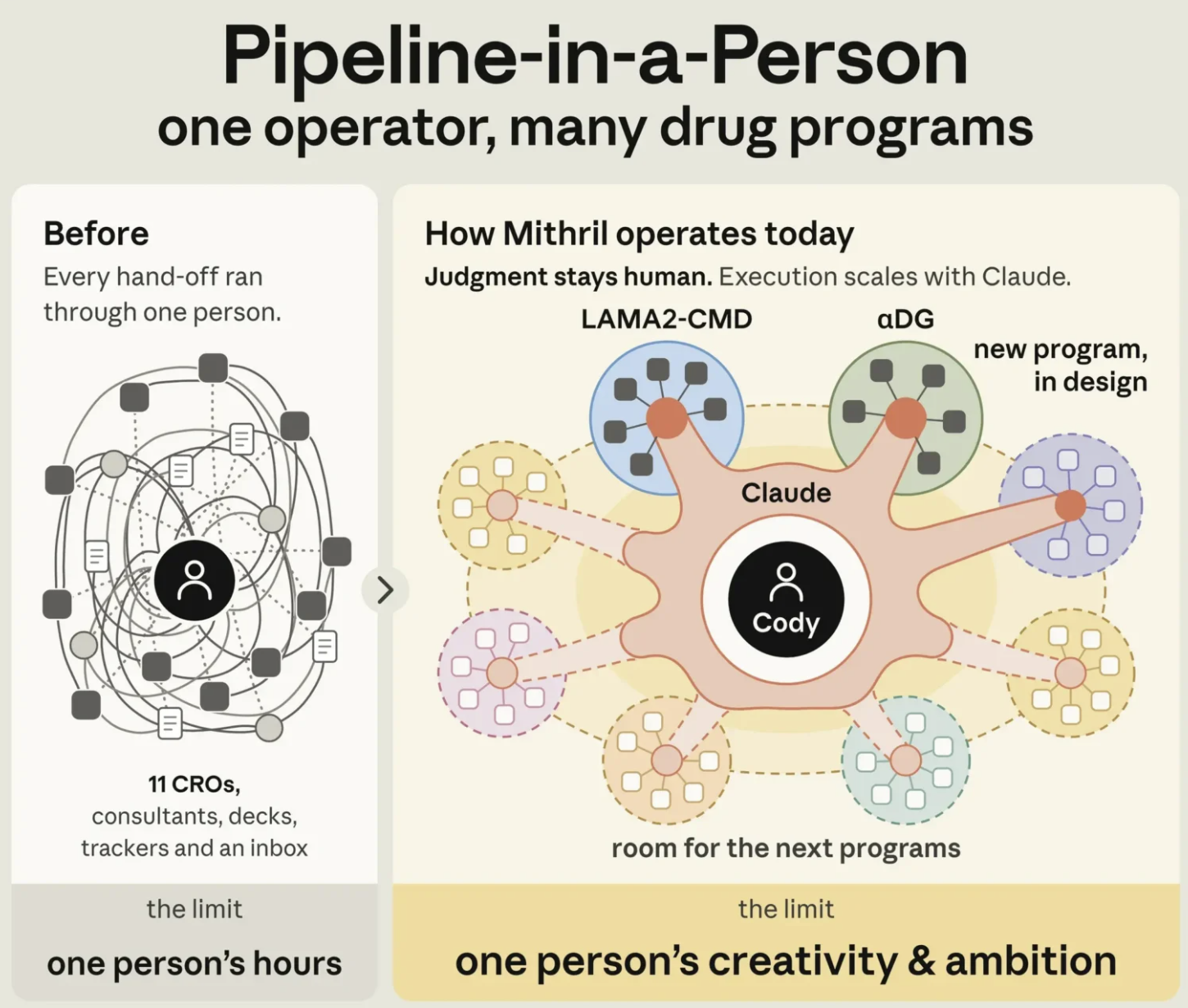
Mithril operated with Tranbarger as its only full-time employee, supported by part-time consultants and 11 external laboratories. He used Anthropic’s Claude AI models to coordinate experiments, manage contracts, organise logistics, analyse data and plan research activities.
This approach helped the company reduce the administrative workload that often slows down early-stage biotechnology research. Rather than employing a large internal team, Tranbarger relied on AI-assisted planning and specialised external laboratories to conduct experiments.
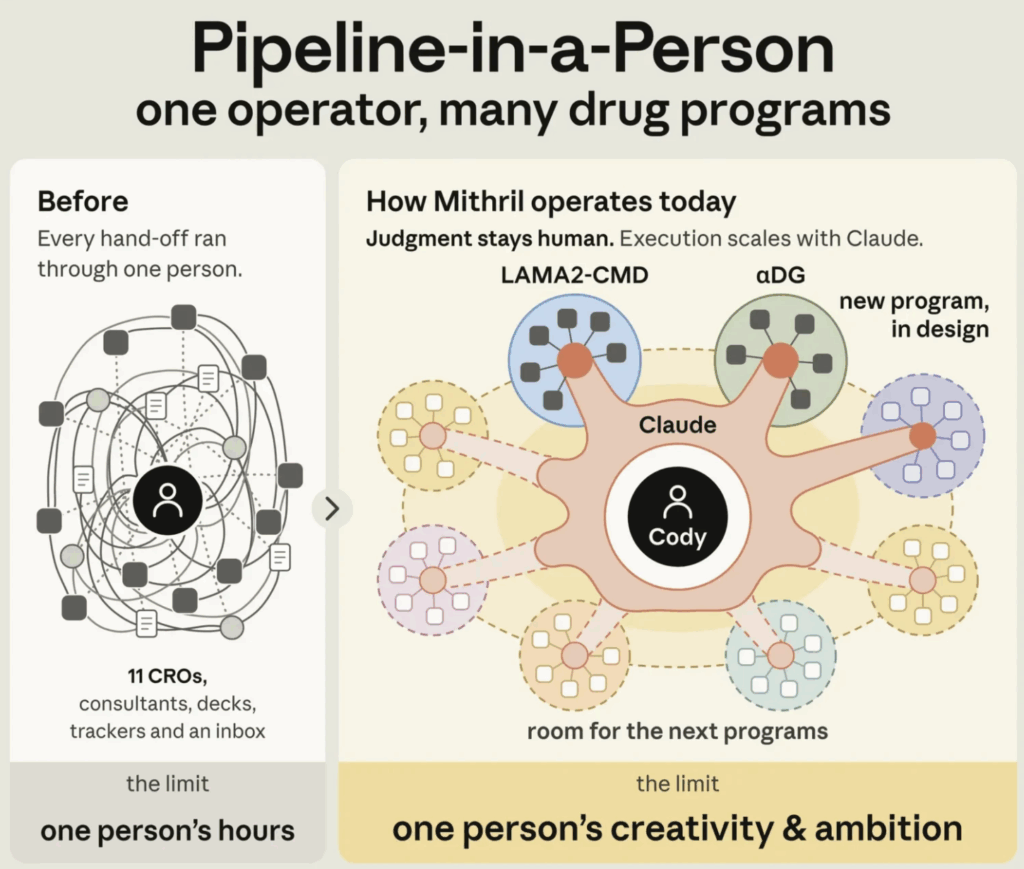
Anthropic describes the model as “Pipeline-in-a-Person”, in which one scientist uses AI to manage multiple research programmes and coordinate work that would traditionally require a larger organisation.
The company says Mithril advanced a potential treatment from an initial concept to promising results in mice in less than 18 months.
Research Targets Two Rare Forms of Muscular Dystrophy
Mithril’s research focuses on LAMA2-related congenital muscular dystrophy and alpha-dystroglycanopathy. Both are rare genetic disorders that can cause severe muscle weakness, often beginning in childhood.
For LAMA2-related congenital muscular dystrophy, the company developed an experimental bispecific antibody designed to help restore the connection between muscle fibres and surrounding tissue.
In an early mouse study, animals receiving one version of the antibody showed approximately twice the grip strength and triceps force of untreated control animals. More treated mice also survived to the end of the study.
These findings are preliminary. The study has limitations, including differences in the timing of experiments, and further controlled research is needed to establish whether the treatment is genuinely effective.
The potential therapies have not been demonstrated to be safe or effective in humans.
Claude Helps Coordinate Hundreds of Experimental Tasks
Anthropic says Claude helped Mithril manage complex laboratory workflows and analyse large volumes of research information.
In one example, Claude summarised a 341-page production report covering 113 antibody constructs in less than eight minutes. It also helped revise experimental plans and associated documents when researchers changed their priorities.
However, the process was not error-free. Anthropic’s account describes mistakes in AI-generated laboratory instructions and data analysis, some of which were initially missed during human review.
The experience illustrates both the potential and limitations of using AI in scientific research. AI can help scientists manage information and coordinate experiments, but human oversight remains essential when errors could affect experimental results.
Anthropic Expands Its Drug Discovery Ambitions
The acquisition forms part of Anthropic’s broader strategy to apply Claude to biotechnology and pharmaceutical research.
The company has also reported collaborations with organisations including Bristol Myers Squibb, BigHat Biosciences, Divergence Labs, Enveda, Generate Biomedicines and The Column Group.
These projects involve tasks ranging from antibody design and laboratory data analysis to clinical trial planning and regulatory documentation.
Anthropic believes AI can reduce bottlenecks throughout drug development, potentially allowing researchers to investigate more treatment candidates with fewer resources.
When Could the Treatment Reach Human Trials?
Anthropic says Mithril aims to select formal drug candidates in 2027. If subsequent studies support the results, the company hopes the LAMA2-related muscular dystrophy programme could enter human clinical trials as early as late 2028. The second programme could follow in 2029.
These are targets rather than confirmed timelines, and progress will depend on further laboratory studies, safety assessments and regulatory requirements.
eThe acquisition highlights a new model for AI-assisted biotechnology, but whether it leads to effective treatments will depend on evidence from rigorous preclinical research and eventual human trials.