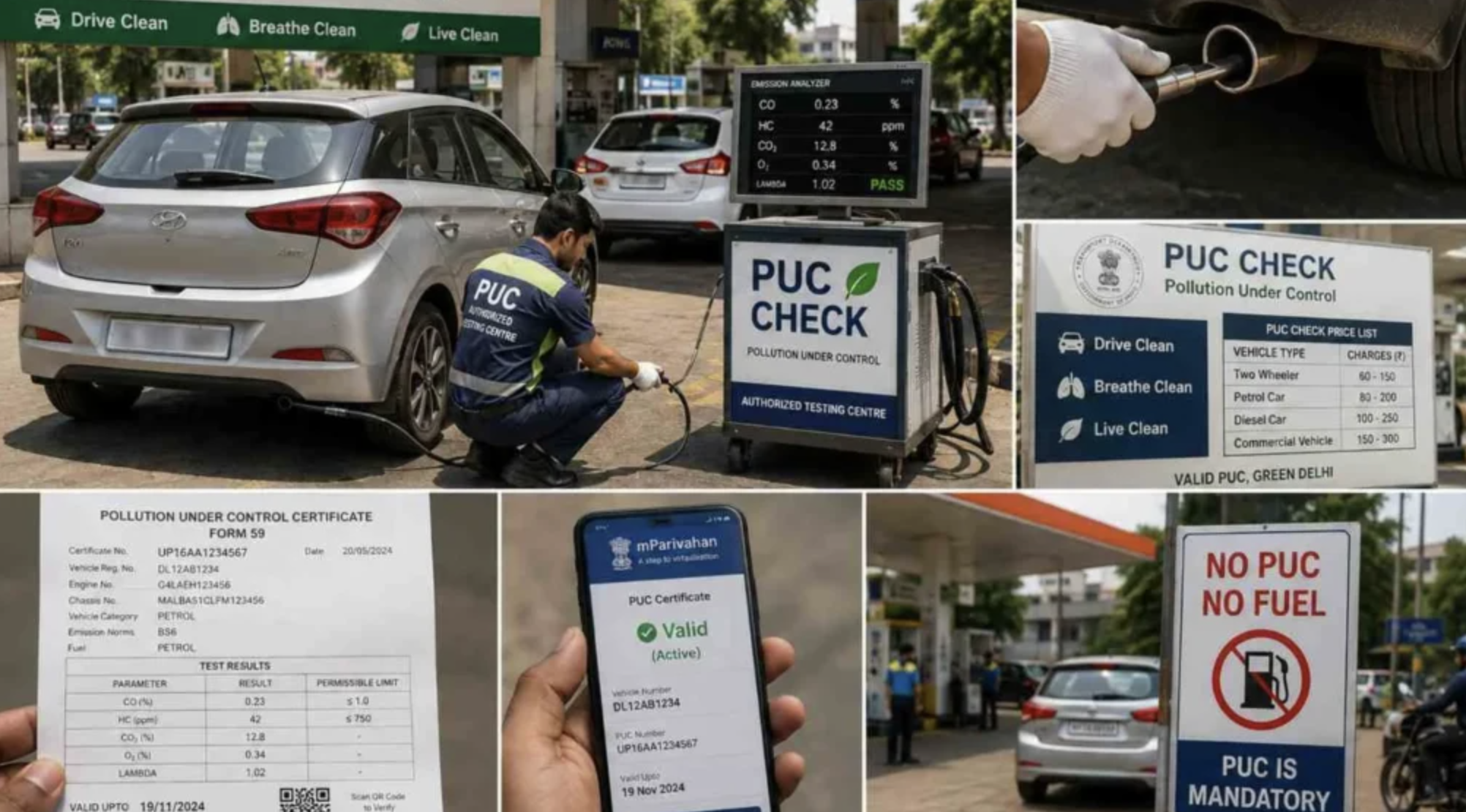


The Ministry of Road Transport and Highways (MoRTH) has revised the validity period of Pollution Under Control (PUC) certificates across India. The new rules introduce different renewal schedules based on a vehicle’s Bharat Stage (BS) emission category, age and whether it is used for private or commercial purposes.
Notified on November 13, 2026, through the Central Motor Vehicles (Sixteenth Amendment) Rules, 2026, the changes amend Rule 115(7) of the Central Motor Vehicles Rules, 1989. The revised framework offers longer certificate validity to newer BS-VI vehicles while requiring older vehicles to undergo emission testing more frequently.
New PUC Validity Rules For BS-VI Vehicles
The biggest benefit under the revised rules is for newer private BS-VI vehicles. Earlier, these vehicles generally received PUC certificates valid for one year, irrespective of their age.
Under the new schedule, private BS-VI vehicles up to six years old will receive certificates valid for three years. Vehicles older than six years but not exceeding 10 years will continue to require annual renewal. Those older than 10 years will need a fresh certificate every six months.
Commercial or transport BS-VI vehicles will follow a slightly different schedule:
- Up to six years old: Two years
- More than six years and up to 10 years: One year
- More than 10 years: Six months
The vehicle’s age will be calculated from its date of first registration.
BS-I To BS-III Vehicles Must Renew PUC Every Three Months
Owners of vehicles complying with older emission standards will face more frequent testing.
Under the revised rules, all BS-I, BS-II and BS-III vehicles will receive PUC certificates valid for just three months, irrespective of their age or whether they are privately or commercially registered.
Previously, the central rules generally allowed a six-month validity period, although some states, including Delhi, already followed a three-month renewal requirement.
The new framework standardises this requirement across the country.
BS-IV Vehicles Get Six-Month Validity
BS-IV vehicles will now have a uniform PUC certificate validity of six months.
Earlier, the central rules generally allowed a 12-month validity period, although certain states and parts of the National Capital Region already followed a shorter six-month schedule.
The revised regulation makes six months the standard validity period across India for all BS-IV vehicles.
Complete Comparison Of Old And New PUC Rules
| Vehicle category | New PUC validity |
|---|---|
| BS-I, BS-II and BS-III | 3 months |
| BS-IV | 6 months |
| BS-VI private, up to 6 years | 3 years |
| BS-VI private, over 6 to 10 years | 1 year |
| BS-VI private, over 10 years | 6 months |
| BS-VI commercial, up to 6 years | 2 years |
| BS-VI commercial, over 6 to 10 years | 1 year |
| BS-VI commercial, over 10 years | 6 months |
What Happens To Existing PUC Certificates?
Vehicle owners do not need to obtain a fresh PUC certificate immediately because of the new rules.
Certificates issued before the amendment came into force will remain valid until their existing expiry dates. The revised validity schedule will apply when the certificate is renewed for the first time after the amendment.
The government has also clarified the calculation of renewed certificate validity. If a vehicle undergoes testing within 10 days before the existing certificate expires, the renewed certificate will take effect from the previous certificate’s expiry date.
However, if the test is conducted on or after the expiry date, the new certificate will become valid from the date of renewal.
Summary
The new PUC rules introduce vehicle-age-based renewal schedules across India. Newer private BS-VI vehicles will receive three-year certificates, while older BS-I to BS-III vehicles will need testing every three months. Existing certificates remain valid until expiry, with the revised schedule applying at the first renewal after the amendment takes effect.