Bengaluru’s metro network has crossed another major milestone with the arrival of its first driverless metro train. The train, manufactured by BEML, is expected to operate on the upcoming Blue Line of Namma Metro, which will connect key parts of the city, including the Kempegowda International Airport. The development marks a significant step towards modernizing public transportation in one of India’s fastest-growing metropolitan regions.
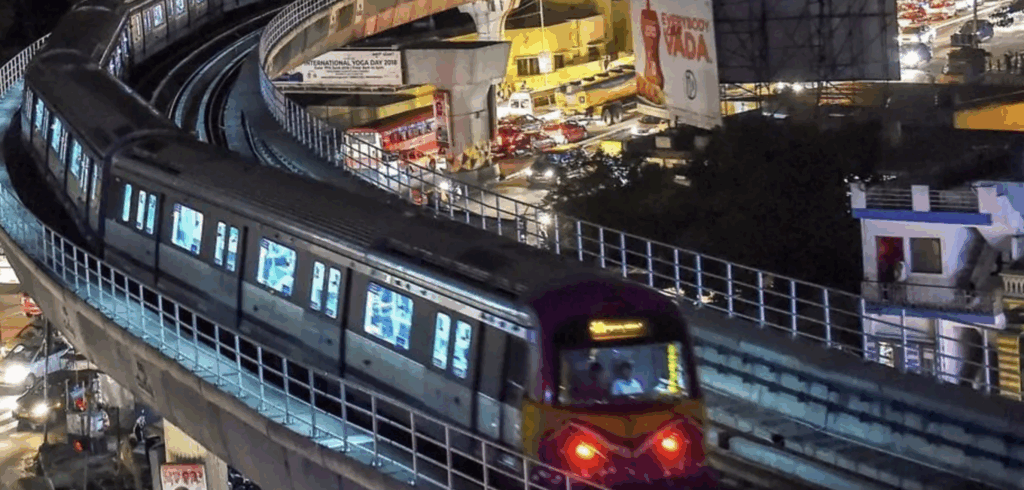
First Driverless Train Arrives in Bengaluru
The six-coach driverless metro train recently arrived in Bengaluru and will undergo extensive testing before entering commercial service. The train is part of the larger Phase 2A and Phase 2B expansion projects being implemented by the Bangalore Metro Rail Corporation Limited (BMRCL).
Officials believe the new trains will improve operational efficiency, reduce human intervention, and enable more frequent metro services as passenger demand grows across the city.
Advanced Technology and Safety Features
The driverless trains are equipped with Communication-Based Train Control (CBTC) technology, which allows trains to operate automatically while maintaining high safety standards. The system continuously monitors train movements and helps optimize speed, braking, and scheduling.
The trains also feature modern passenger information systems, CCTV surveillance, emergency communication facilities, energy-efficient systems, and enhanced accessibility features for commuters.
Although the trains are capable of operating without drivers, metro authorities are expected to maintain operational supervision during the initial phases to ensure smooth functioning.
Blue Line Set to Transform Airport Connectivity
The driverless trains will eventually run on the Blue Line, one of Bengaluru’s most anticipated metro corridors. The line is expected to provide direct connectivity to Kempegowda International Airport while linking several major residential and commercial hubs.
Once operational, the corridor is expected to significantly reduce travel time for airport-bound passengers and ease pressure on Bengaluru’s heavily congested road network.
Boost for Bengaluru’s Public Transport Network
Bengaluru’s population and vehicle numbers have grown rapidly over the past decade, leading to severe traffic congestion. Metro expansion has become a key strategy for improving urban mobility and reducing dependence on private vehicles.
The introduction of driverless technology also places Bengaluru among a growing list of global cities adopting automated metro systems to improve reliability, safety, and efficiency.
What Happens Next?
Before passengers can ride the driverless trains, authorities will conduct multiple rounds of testing, integration, and safety certification. Additional train sets are also expected to arrive in the coming months as work on the Blue Line progresses.
The successful deployment of driverless metro services could pave the way for wider adoption of automated transit systems across India.
Summary
Bengaluru has received its first driverless metro train for the upcoming Blue Line corridor. Equipped with advanced CBTC technology and modern safety systems, the train will undergo extensive testing before commercial operations begin. The project is expected to improve airport connectivity, reduce traffic congestion, and mark a major step forward in the modernization of Bengaluru’s public transportation network.