Samsung Electronics has reportedly agreed to provide an average bonus of around 5.6 million won — roughly ₹2.8 lakh to ₹3.3 lakh — to employees in its semiconductor business following a major labour strike settlement in South Korea.
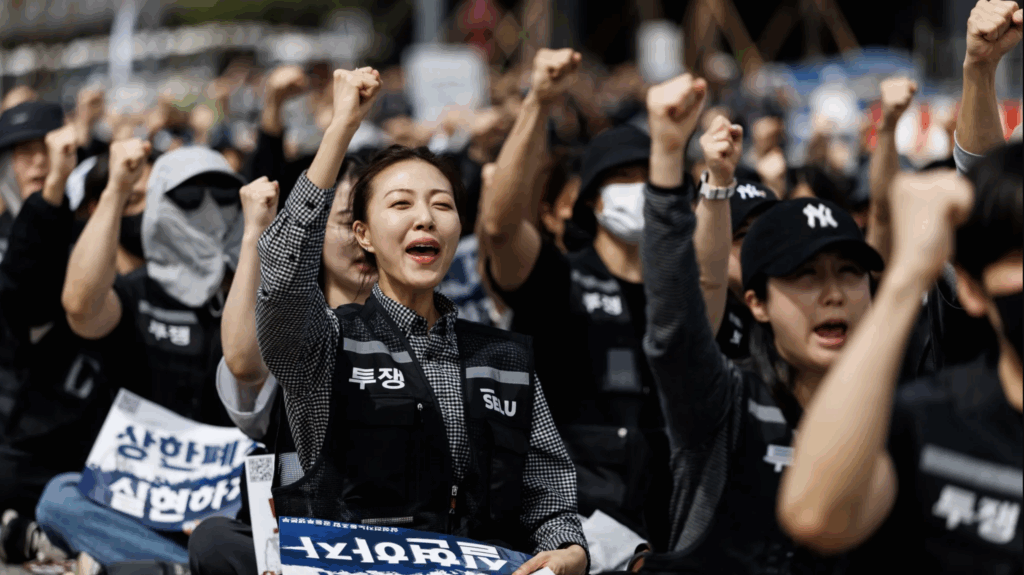
The agreement comes after months of tension between the company and workers, marking one of the most significant labour developments in Samsung’s recent history.
Samsung’s semiconductor division is one of the company’s most critical businesses, powering chips used in smartphones, AI systems, servers, memory solutions, and advanced computing infrastructure globally.
The strike had attracted worldwide attention because Samsung has historically maintained a tightly controlled corporate culture with limited union influence for decades.
Why The Strike Became So Important
The semiconductor industry is currently under enormous global pressure due to the explosive growth of artificial intelligence, high-performance computing, and data center demand.
Employees reportedly pushed for better compensation, performance-linked incentives, and improved working conditions amid rising corporate profits and growing workloads.
Labour unions argued that workers should receive greater benefits as Samsung competes aggressively in the global AI chip race against companies like TSMC, Intel, and SK Hynix.
The eventual settlement is being viewed as a major symbolic victory for organized labour within South Korea’s technology sector.
Samsung’s Semiconductor Business Is Crucial Globally
Samsung is one of the world’s largest semiconductor manufacturers and plays a critical role in the global electronics supply chain.
Its chip division produces:
- DRAM memory chips
- NAND storage chips
- AI accelerator components
- Smartphone processors
- Foundry manufacturing solutions
The company is investing billions of dollars to strengthen its semiconductor dominance, especially as artificial intelligence dramatically increases demand for advanced chips worldwide.
Industry analysts believe maintaining workforce stability is now becoming just as important as technological leadership.
Global Chip Industry Competition Intensifying
| Company | Core Strength | Current Focus |
|---|---|---|
| Samsung | Memory chips + Foundry | AI chip expansion |
| TSMC | Advanced chip manufacturing | Global foundry leadership |
| Intel | CPUs + AI infrastructure | Manufacturing comeback |
| SK Hynix | AI memory chips | HBM dominance |
| NVIDIA | AI GPUs | AI computing boom |
The semiconductor sector is currently witnessing one of the most aggressive technology races in decades due to the global AI boom.
Rising Labour Influence In Tech Sector
Samsung’s agreement with workers also reflects a broader trend happening across the global technology industry.
Employees in major tech and manufacturing firms are increasingly demanding:
- Better compensation
- Reduced workload pressure
- Greater job security
- Performance-linked incentives
- Improved work-life balance
As semiconductor companies push for faster innovation cycles, workers argue that employee welfare should grow alongside corporate expansion.
Experts believe labour relations may become a more important factor in the future competitiveness of technology companies worldwide.
AI Boom Increasing Pressure On Semiconductor Firms
The artificial intelligence revolution has dramatically increased pressure on chip manufacturers globally.
Companies are now racing to produce faster AI processors, advanced memory systems, and next-generation semiconductor technologies to support:
- AI chatbots
- Autonomous systems
- Cloud computing
- Data centers
- Generative AI infrastructure
This rapid expansion has increased production demands on semiconductor employees and manufacturing facilities.
Samsung is currently investing heavily to strengthen its position in the AI-driven semiconductor market, particularly against TSMC and NVIDIA-led ecosystem growth.
A Turning Point For Samsung’s Corporate Culture?
Many analysts believe the settlement may represent a larger cultural shift inside Samsung.
For decades, Samsung was known for maintaining strong centralized control with limited labour activism. However, employee unions have gradually gained influence in recent years.
The latest settlement suggests the company may now need to adopt a more collaborative approach toward workforce management as global labour expectations evolve.
The development could also influence labour negotiations across South Korea’s broader technology and manufacturing industries.
As the global AI race intensifies, balancing innovation, profitability, and employee satisfaction may become one of the biggest long-term challenges for major tech companies like Samsung.