The Tata Group has unveiled one of the largest private sector investments in India’s tech infrastructure — a $11 billion commitment to build a state-of-the-art Innovation City in Maharashtra. Announced at the World Economic Forum (WEF) 2026 in Davos, this project reflects a bold vision to transform the region into a global centre for artificial intelligence, innovation, and semiconductor services.
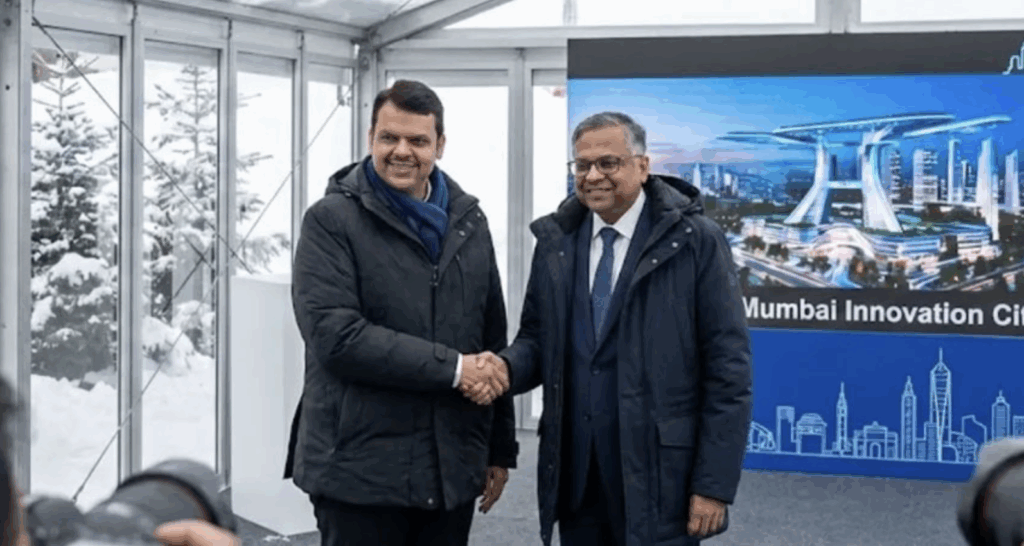
Maharashtra Chief Minister Devendra Fadnavis highlighted the project’s strategic importance on the sidelines of the WEF, noting strong international investor interest and the ambition to support India’s rise as a technological powerhouse.
A New Tech Corridor Next to Navi Mumbai Airport
The Innovation City is planned close to the Navi Mumbai International Airport (NMIA), leveraging its global connectivity. The proximity to a major international transport hub is central to the project’s design, enabling rapid access for businesses, talent, and international partners.
The city is being designed as a “plug-and-play” ecosystem, meaning ready infrastructure and facilities will allow startups and established firms to set up quickly. Developers aim to provide seamless integration of digital services, high-capacity data infrastructure, and research-ready environments.
Focus on AI, Semiconductors and Data Infrastructure
A key anchor for the Innovation City will be advanced data centres, crucial for supporting next-generation artificial intelligence applications, cloud services, and semiconductor design and testing facilities. This aligns with global trends — tech giants like Microsoft, Alphabet and Amazon are also rapidly expanding their data centre footprints worldwide to meet rising AI demand.
The project positions India to capture a growing share of global AI innovation, especially as foreign investment accelerates in the sector. According to industry estimates, global data centre capacity demand may more than triple by 2030, underscoring the strategic timing of this investment.
Economic and Strategic Implications
Beyond technology infrastructure, the Innovation City is expected to generate extensive employment opportunities and attract both domestic and global talent. It is part of broader efforts by the Maharashtra government to draw investment into the state and support economic growth.
The initiative also forms a key component of a larger suite of deals announced at Davos, with the state securing a wide array of Memoranda of Understanding (MoUs) that collectively aim to boost job creation and economic activity in the region.
Timeline and Global Ambition
While detailed project timelines are still being finalised, officials indicate that planning and preparatory work will progress over the next several months. The government aims to begin construction within about six to eight months of the announcement.
By anchoring this massive investment to the new Navi Mumbai airport and integrating deep-tech infrastructure, the Innovation City could help position Maharashtra — and India — as a formidable global destination for AI, semiconductors, and cutting-edge research.
Conclusion
The Tata Group’s $11 billion Innovation City marks a major step in India’s tech ecosystem transformation. By building next-generation infrastructure near a strategic transport hub and focusing on AI and semiconductor capabilities, Maharashtra is betting on a future where technology, innovation, and economic growth intersect at scale.