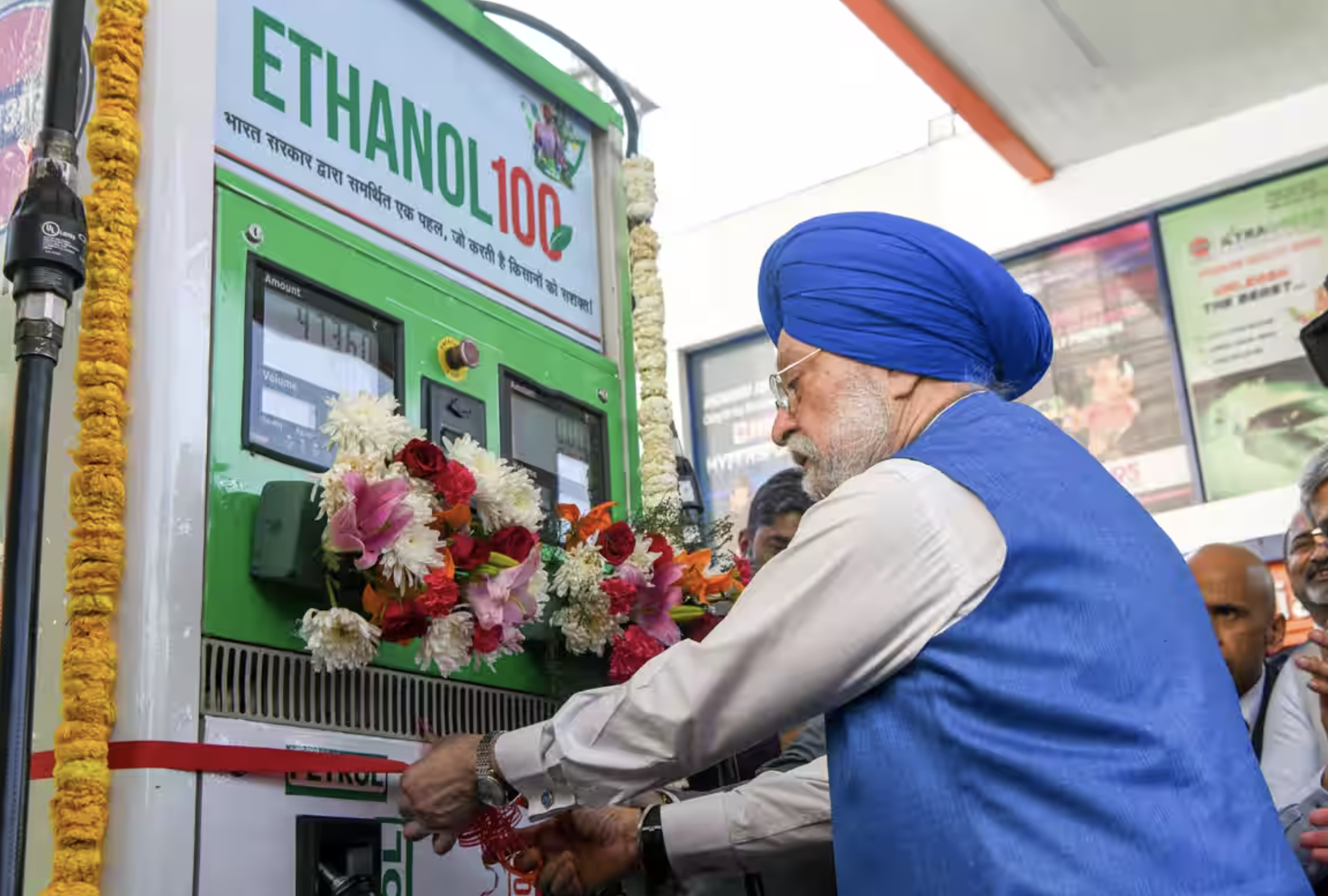


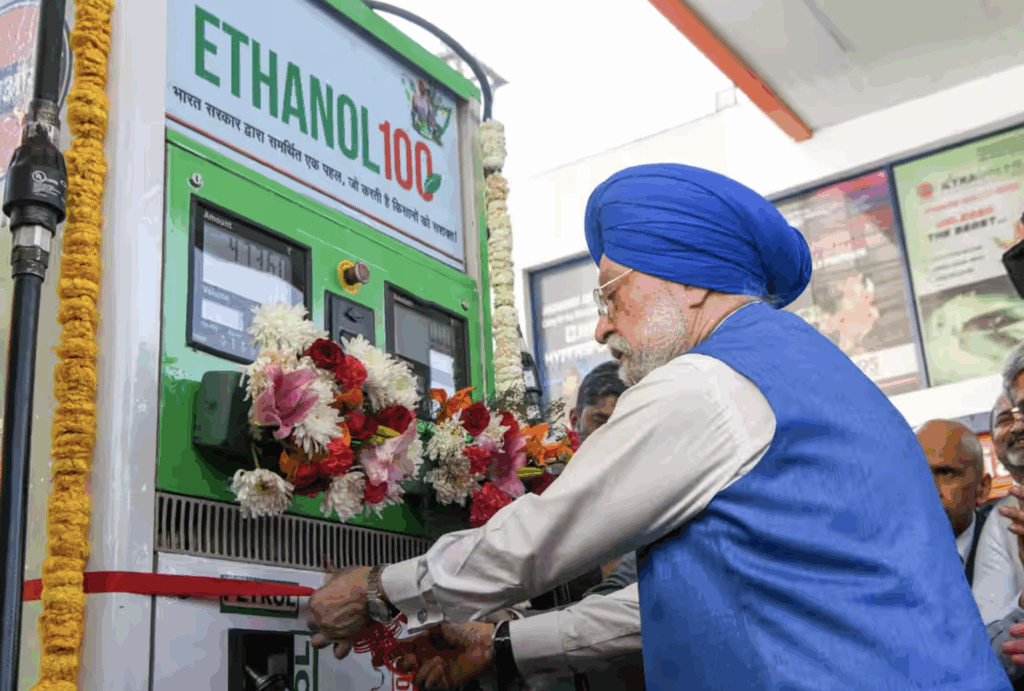
India has officially amended its motor vehicle rules to allow vehicles specifically designed to run on E100 fuel, which consists almost entirely of ethanol. The decision creates a regulatory pathway for automakers to introduce flex-fuel cars capable of operating on high-ethanol fuel blends, as the government looks to reduce dependence on imported crude oil.
The Ministry of Road Transport and Highways notified amendments to the Central Motor Vehicles Rules, 1989, incorporating E100 alongside E85 in provisions covering vehicle emissions, fuel specifications and testing requirements.
What Is E100 Fuel?
E100 refers to fuel containing nearly 100 per cent ethanol. Ethanol is an alcohol-based fuel commonly produced from agricultural feedstocks such as sugarcane and other biomass sources.
For comparison, E20 petrol contains 20 per cent ethanol and 80 per cent petrol, while E85 contains up to 85 per cent ethanol.
Flex-fuel vehicles are engineered to operate on different proportions of petrol and ethanol. Depending on their design and certification, they can use conventional petrol blends as well as higher-ethanol fuels, potentially extending to E100.
Can Existing Petrol Cars Run on E100?
No. The government has clarified that E85 and E100 are intended exclusively for vehicles specifically designed and certified to use these fuels.
Existing petrol cars, including vehicles compatible with E20 petrol, cannot automatically use E85 or E100. Their fuel-system components and engine-management systems may not be suitable for such high ethanol concentrations.
Motorists should check their vehicle’s fuel compatibility sticker and owner’s manual before choosing a fuel. The new rules do not require existing vehicle owners to modify their cars or switch to higher-ethanol fuels.
What Has the Government Changed?
The amendments formally recognise E100 in the relevant provisions of the Central Motor Vehicles Rules. They update emission-related tables, fuel specifications and vehicle testing requirements, giving manufacturers a clearer regulatory framework for developing and certifying compatible vehicles.
The government has also raised the relevant gross vehicle weight threshold from 3,000 kg to 3,500 kg.
The changes follow a consultation process that began with draft amendments published in April 2026. The final notification establishes the regulatory provisions needed for vehicles designed to use higher ethanol blends.
Which Automakers Are Preparing for Flex-Fuel Cars?
Maruti Suzuki, Toyota, Tata Motors and Hyundai are among the manufacturers associated with flex-fuel vehicle development for India.
Maruti Suzuki’s Wagon R Flex Fuel has been presented as a model capable of running on ethanol-petrol blends ranging from E20 to E100. However, regulatory approval for E100 does not automatically mean that compatible vehicles or the fuel itself will be widely available immediately.
Manufacturers will still need to meet applicable certification requirements, while fuel suppliers and retailers will need to support the availability of the relevant blends.
Will E100 Reduce Petrol Dependence and Emissions?
The government hopes that greater use of domestically produced ethanol will reduce India’s reliance on imported crude oil and support the domestic agricultural and biofuel industries.
Higher ethanol blends can reduce certain exhaust pollutants. However, the overall environmental benefit depends on how the ethanol is produced, the feedstock used and the vehicle’s efficiency across different fuels.
Ethanol also contains less energy per litre than petrol, which can affect fuel economy and driving range.
What Happens Next?
The rule change is an important regulatory step towards introducing more flex-fuel vehicles in India. However, widespread adoption will depend on vehicle prices, fuel availability, operating costs and the expansion of suitable refuelling infrastructure.
For drivers, the key takeaway is straightforward: E100 is now recognised under the amended rules for compatible, certified vehicles, but ordinary petrol cars cannot use it simply because the fuel has received government approval.