Like a city learning to stand on its toes, Hyderabad has risen until the horizon itself had to look up.
A Skyline That Rewrote the Map
Hyderabad is no longer defined only by its old bazaars, heritage structures and expansive neighbourhoods. Look upward today and a different narrative unfolds. Glass-clad towers and luxury residences rising 40 and even 50 floors high have quietly reshaped the city into India’s tallest urban centre. In sheer vertical growth, Hyderabad has surged ahead of Gurugram, Noida, Bengaluru, Pune and Kolkata, signalling a decisive shift in how Indian cities are choosing to expand.
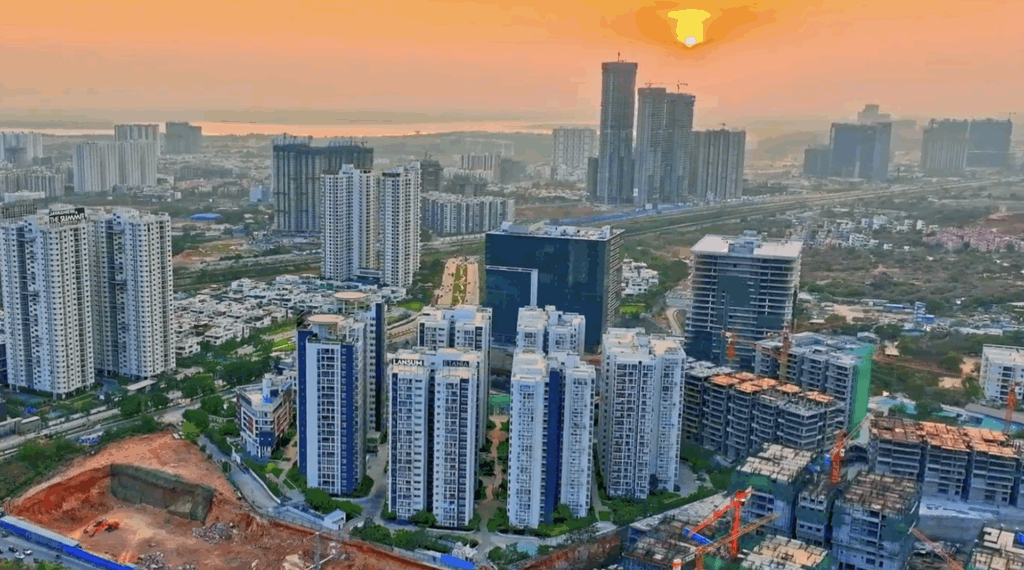
Over the past decade, the city has witnessed an unprecedented boom in high-rise residential and commercial construction, especially along the IT corridor stretching from Gachibowli to Kokapet and the Financial District. Liberal floor space index norms, faster project approvals, availability of large land parcels, and sustained demand from IT professionals and investors have powered this ascent. Unlike older metros burdened by fragmented land ownership, Hyderabad has been able to grow vertically in cohesive clusters, creating dense skylines rather than isolated towers. Luxury residential skyscrapers have thus become a defining feature of its urban identity.
Why Other Cities Fell Short
Elsewhere, height has come with constraints. Gurugram and Noida, despite their reputation for high-rise living, face regulatory bottlenecks, infrastructure strain and uneven planning. Their towers often stand as scattered pockets rather than part of a continuous vertical cityscape, limiting overall scale. Bengaluru, India’s tech capital, has largely expanded outward instead of upward. Strict zoning laws, airport height restrictions and civic resistance to dense development have kept most neighbourhoods mid-rise, resulting in a skyline that spreads wide rather than climbs high.
Pune’s growth has been similarly cautious, shaped by defence land, environmental norms and planning restrictions. Kolkata, too, has prioritised heritage conservation and cautious urban development, confining skyscrapers to limited zones like New Town and Rajarhat. Urban planners argue Hyderabad stands apart due to a rare alignment of pro-growth policies, streamlined approvals, modern infrastructure and strong IT-led demand. The result is a city that has embraced vertical living at scale, redefining how urban India imagines density and growth.
In Hyderabad, the future isn’t just arriving—it’s stacking itself floor by floor against the sky.
Summary
Hyderabad has emerged as India’s tallest city, outpacing major metros through rapid high-rise development over the past decade. Driven by liberal building norms, faster approvals, large land parcels and IT-sector demand, the city has built dense vertical clusters. Unlike other metros constrained by regulations, Hyderabad’s skyline reflects a bold shift toward vertical urban growth.