Astronomers Detect Radio Emission From Distant Planet
Astronomers have reported the first direct detection of radio emission originating from a planet outside our Solar System, marking a major breakthrough in the study of distant worlds.
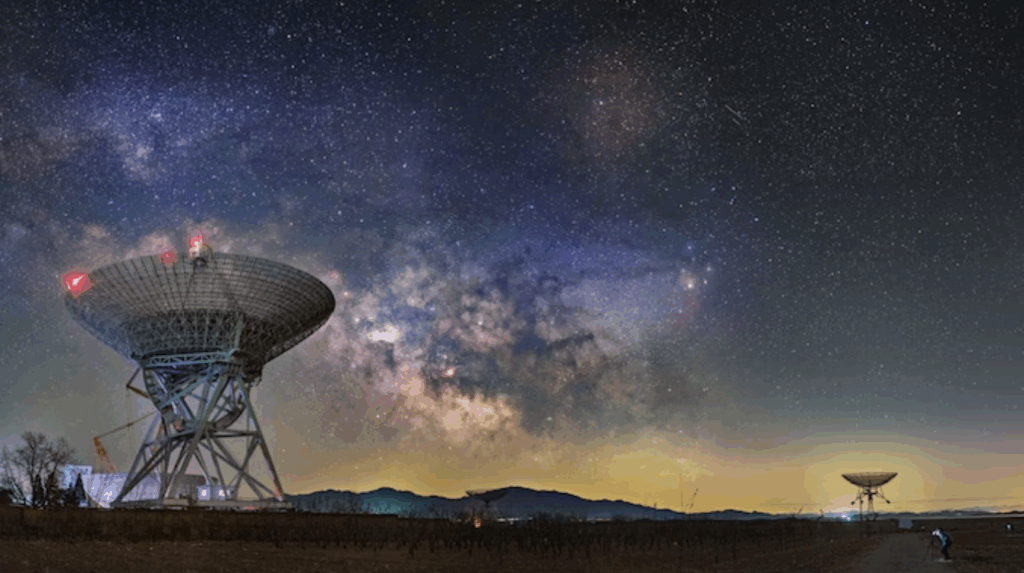
The signal appears to have come from Beta Pictoris b, a massive gas giant located around 63 light-years from Earth. Scientists say the discovery is not evidence of alien communication, but instead provides important information about the planet’s extremely powerful magnetic field.
Beta Pictoris b Is A Giant World
Beta Pictoris b is around 12 times more massive than Jupiter and orbits a young star that is approximately 23 million years old.
The planet is part of the Beta Pictoris system, one of the most closely studied planetary systems in our galaxy. The system contains several planets as well as a large disk of dust and debris left over from planetary formation.
The planet itself was first discovered in 2008.
Radio Signal Came From A Powerful Magnetic Field
Researchers believe the detected radio bursts were produced by auroras generated around Beta Pictoris b’s magnetic poles.
Charged particles interacting with a planetary magnetic field can produce auroras as well as radio waves. Similar processes occur on planets such as Jupiter and Saturn.
The observations suggest that Beta Pictoris b has a magnetic field at least 200 times stronger than Earth’s and potentially far stronger than Jupiter’s in the relevant region.
MeerKAT Telescope Made The Detection
The discovery was made using MeerKAT, a network of 64 radio telescope dishes located in South Africa.
Scientists detected repeating radio bursts across multiple observing sessions and frequencies. Crucially, researchers were able to distinguish the radio emission from the planet rather than its host star.
That distinction is important because earlier radio signals associated with exoplanetary systems could not be conclusively traced to the planets themselves.
This Is Not An Alien Signal
The discovery may sound like the kind of radio transmission associated with the search for extraterrestrial intelligence, but scientists have stressed that there is no evidence of an intelligent source.
Instead, the radio emission appears to be a natural consequence of Beta Pictoris b’s powerful magnetic environment.
The finding could nevertheless have major implications for the search for habitable worlds because magnetic fields can help protect planetary atmospheres from energetic particles and stellar winds.
Scientists Still Want More Observations
The research has not yet completed peer review, and independent scientists have urged caution until the results undergo further scrutiny.
If confirmed, the discovery would give astronomers a completely new way to study exoplanets. Radio observations could reveal information about magnetic fields, atmospheres and interactions between distant planets and their surrounding environments.
Researchers have already requested additional telescope observations to understand why Beta Pictoris b has such an unusually powerful magnetic field.
A New Way To Study Alien Worlds
The significance of the discovery goes beyond simply detecting a radio signal from another planet.
For decades, astronomers have relied mainly on techniques such as observing how planets block some of their star’s light or measuring their gravitational influence. Direct radio observations could provide another window into the physical properties of these distant worlds.
If future observations confirm the finding, Beta Pictoris b could become an important benchmark for understanding how magnetic fields work on giant planets beyond our Solar System.
Summary
Astronomers have reported the first direct detection of radio emission from an exoplanet, Beta Pictoris b, located 63 light-years away. The signal appears to be produced by auroras associated with an exceptionally powerful magnetic field, not intelligent life. Detected using South Africa’s MeerKAT telescope, the finding could open a new way to study magnetic fields, atmospheres and environments of distant planets.