

Delhi Police’s ₹15.7 crore tender to install 338 surveillance cameras equipped with facial recognition and other monitoring technologies has come under scrutiny over privacy safeguards, procurement procedures and the potential for expanded public surveillance.
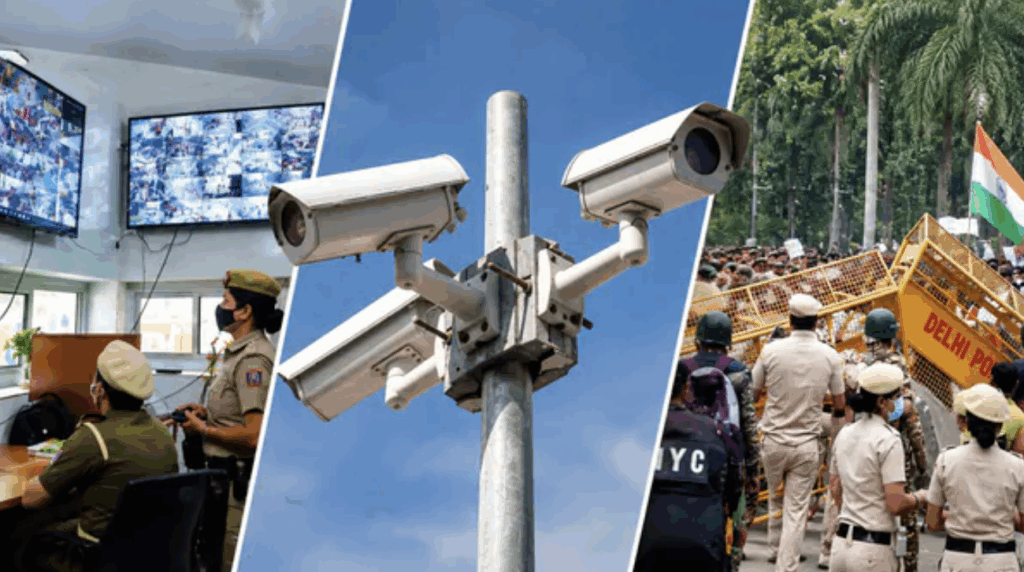
The five-year contract covers cameras across parts of Central and New Delhi, including locations used for public gatherings, traffic management and security. The tender has attracted attention amid protests led by the Cockroach Janta Party (CJP) and wider concerns about the use of facial recognition technology to monitor demonstrators.
However, Delhi Police officials have maintained that the procurement is part of a modernisation programme initiated around two years ago and is not connected to recent protests.
What Does the ₹15.7 Crore Tender Include?
The proposed project involves 338 cameras: 248 fixed cameras, 43 pan-tilt-zoom (PTZ) cameras and 47 automatic number plate recognition (ANPR) cameras. The contract also includes video management software, storage hardware and supporting infrastructure.
The proposed installation locations include Ramlila Maidan’s VVIP gate, Turkman Gate, Delhi Gate, Rajghat, the C-Hexagon area near India Gate, Mandi House and the Patiala House court complex.
Facial recognition technology can compare faces captured by cameras against images stored in selected databases. ANPR cameras, meanwhile, identify vehicle registration plates, potentially helping police track vehicles linked to investigations.
Why Is the Tender Facing Scrutiny?
Digital rights organisation Internet Freedom Foundation (IFF) has raised concerns about gaps in the tender’s technical requirements and privacy protections.
According to its analysis, the documents do not clearly establish a standard operating procedure for facial recognition, require a privacy impact assessment or adequately specify the databases against which faces would be checked.
The organisation has also highlighted the absence of clearly defined accuracy thresholds and safeguards against false matches. These omissions matter because facial recognition systems can incorrectly identify individuals, particularly when image quality, lighting and camera angles are poor.
Questions have also been raised about how long sensitive facial templates, recognition logs and vehicle data would be retained.
IFF Identifies 28 Alleged Procurement Flaws
Beyond privacy, the IFF identified 28 alleged procedural defects in the tender documents.
These reportedly include inconsistencies in camera quantities, technical specifications apparently copied from older tenders, references to outdated independent monitors and inaccurate geographical coordination.