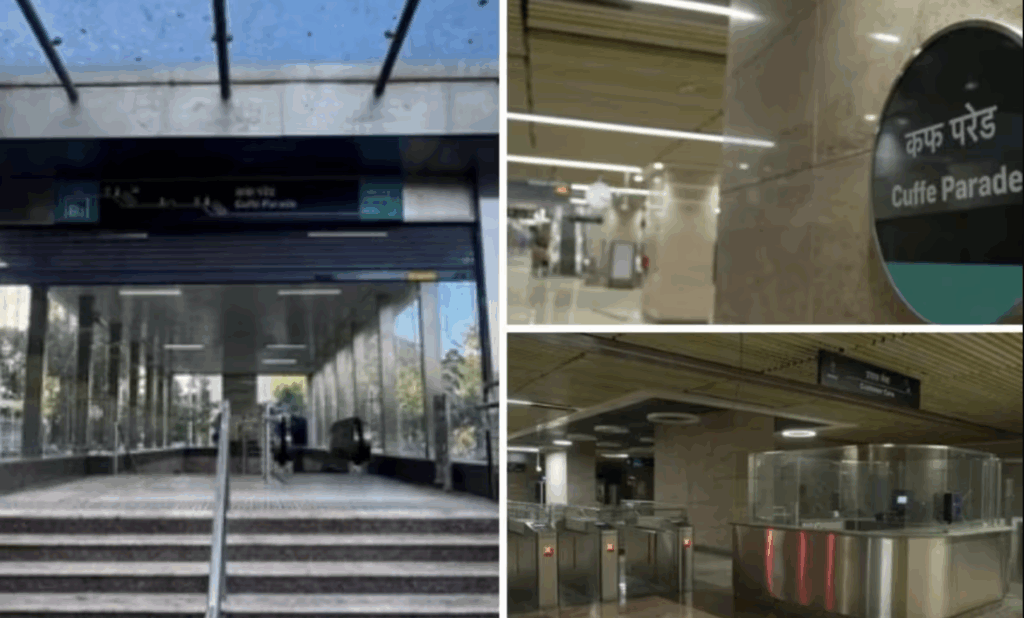
Three months after the final phase of the underground Metro 3, or Aqua Line, between Worli and Cuffe Parade became operational, ridership on the 33.5-km Colaba-Bandra-SEEPZ corridor has seen a remarkable surge.
Passenger numbers more than doubled, rising from 19.7 lakh in September, before the final phase opened, to 38.63 lakh in October. The upward trend continued with 44.58 lakh commuters in November and 46.56 lakh in December. Before the full SEEPZ–BKC–Colaba stretch was launched on October 9, the weekday average ridership stood at 75,052.
This jumped significantly to 1.23 lakh in October, increased further to 1.32 lakh in November, and reached 1.48 lakh in December. The single highest daily ridership was recorded on October 16, when 1.82 lakh passengers used the line.
MMRCL Enhances Metro 3 Operations Amid Sharp Rise in Passenger Numbers
To accommodate rising demand, services on Metro 3 were enhanced from January 5. Weekday trips increased from 265 to 292, effectively reducing peak-hour frequency from over six minutes to nearly three minutes. On Saturdays, the number of trips went up from 209 to 236, while Sunday services continue at 198 trips. Ridership growth has been strongest at stations offering interchanges with suburban rail or other Metro routes. Marol Naka, which links to Metro Line 1 between Andheri and Ghatkopar and serves commuters connecting from the Dahisar East–Andheri East Metro Line 7, registered the highest footfall, with 16.45 lakh entries and exits between October and December. CSMT station followed with 10.28 lakh users.
The BKC station, located in a major commercial hub, recorded the third-highest footfall at 7.3 lakh commuters during this period. Siddhivinayak in Prabhadevi and Santacruz stations also saw strong numbers, each handling nearly 6.66 lakh passengers. An MMRCL spokesperson said the current focus is on boosting ridership by improving last-mile connectivity. This initiative includes a partnership with Cityflo buses at five stations—BKC, Worli, Aarey, JVLR, and CSMT—offering services starting at ₹9. During peak hours, buses run every 10 minutes, with frequency being scaled up based on demand.
Summary:
Metro 3 ridership surged after the final phase opened, doubling from September to December and hitting a peak of 1.82 lakh commuters in a day. To meet demand, MMRCL increased services and improved frequency. Key interchange stations saw the highest footfall, supported by enhanced last-mile connectivity through Cityflo buses.