The Maharashtra government has rolled out its first-ever statewide outdoor hoarding policy, moving beyond the earlier framework that only applied to Mumbai since 1988.
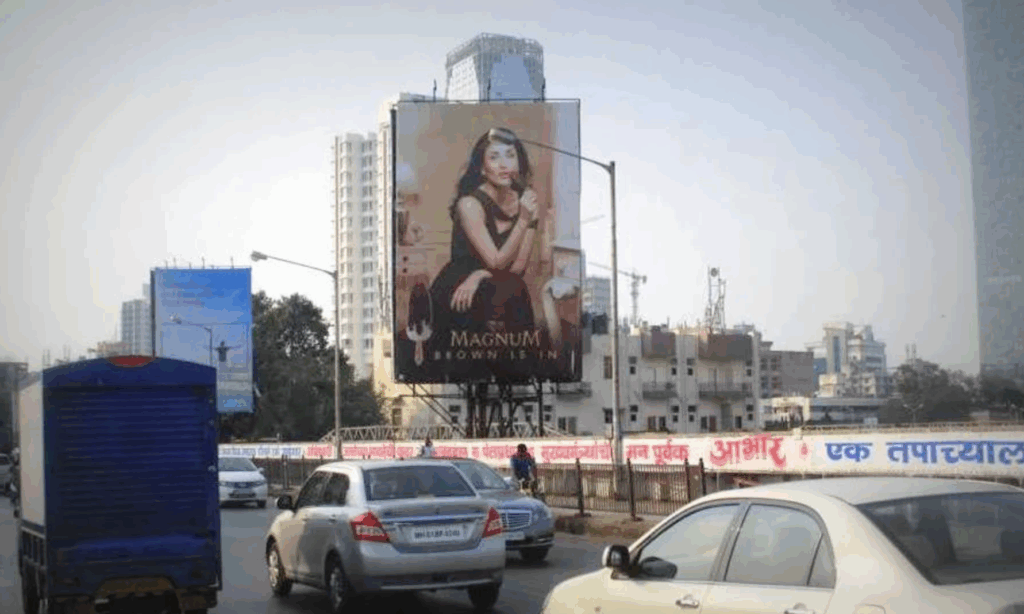
The new policy has been issued through a Government Resolution (GR) by the Revenue and Forest Department, and it aims to auction vacant government land across all districts for advertising hoardings.
Maharashtra Introduces First-Ever Statewide Outdoor Hoarding Policy
By implementing this system, the state expects to generate hundreds of crores in non-tax revenue, while also creating uniform rules that apply across urban, semi-urban, and rural regions.
The initiative is also being projected as a reform that will increase transparency, improve land use, and create jobs. However, given that it is being introduced in an election year, political debates over the control of outdoor publicity space are likely to arise.
The policy makes it clear that political hoardings will not be permitted during election periods, in line with the Model Code of Conduct.
Officials have described the policy as a long overdue step, citing the massive growth in advertising demand across Maharashtra’s towns, cities, and rural markets.
The framework includes clear procedures for e-auctions, eligibility requirements, reporting standards, and penalties for rule violations.
District Collectors To Identify Sites Under Maharashtra’s New Hoarding Policy
District Collectors will now play a key role, as they have been empowered to identify suitable sites, whether highways, semi-urban stretches, or rural markets, and conduct exclusive digital e-auctions for hoarding space.
Each district will function as a single auction unit, with oversight by committees led by the Collector and Resident Deputy Collectors acting as nodal officers.
The reserve price for hoarding leases will be calculated using a formula tied to land value and the Marginal Cost of Lending Rate (MCLR).
In prime locations such as municipal corporation areas, A-class municipalities, and highways, the base value will be set at five times the land’s notified value multiplied by the MCLR. For smaller towns and rural areas, it will be three times the value.
Bids will cover the entire five-year lease period upfront, providing the government with large advance inflows.
Successful bidders will have to deposit one year’s license fee as security, while annual license fees will either match those fixed by municipal bodies or be determined by the Collector with divisional approval.
Criteria For Bidding
Only advertising firms that are registered with the Directorate General of Information and Public Relations (DGIPR), have at least five years of experience, and can show a turnover double the reserve price in the last three years will be eligible to bid.
Applicants must also be based in Maharashtra, ensuring that local firms get preference.
Each lease will last five years, with a renewal option for another five years at a 25% higher fee, provided all rules are followed.
Winning bidders will also be required to provide free hoarding space for government campaigns for at least seven days every quarter.
Once a lease ends, the hoardings must be dismantled at the cost of the allottee.
If the allottee fails to remove the hoarding, their deposits will be forfeited and they will be blacklisted from future auctions.
Any lease violation may result in immediate cancellation and a penalty equivalent to double the rent for three years.
The policy strictly requires that hoardings must not block traffic signals, compromise public safety, or cause environmental damage.
All insurance and safety measures are the full responsibility of the allottee. In the event of accidents, liability will rest entirely with the advertising lessee.
During elections, and specifically under the Model Code of Conduct, political hoardings will be strictly prohibited.
Finally, Collectors are tasked with maintaining monthly reports, digital records, and swift enforcement against unauthorized hoardings or encroachments.