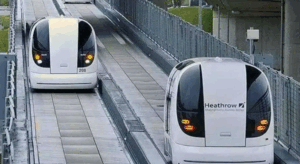
In a major push toward next-generation urban mobility, the Maharashtra government has directed the Mumbai Metropolitan Region Development Authority (MMRDA) to launch feasibility studies for India’s first pod taxi network. The proposed system will connect Thane, Navi Mumbai, and Mira-Bhayandar—three rapidly growing urban zones grappling with chronic traffic congestion and long travel times.
The project, initiated under Chief Minister Eknath Shinde’s leadership, will operate through a public-private partnership model, with the MMRDA as the nodal agency. Private companies have been invited to submit technical and financial proposals based on preliminary survey results.

Solving Congestion in High-Growth Cities
These regions have witnessed explosive population growth, intensifying pressure on road infrastructure. Pod taxis—small, driverless, electric vehicles running on elevated guideways—offer an efficient and environmentally friendly solution. The system promises zero tailpipe emissions, minimal noise, and seamless integration with metro, bus, and road networks. By operating above existing roads, it avoids costly land acquisition and reduces the burden on already congested routes.
The project builds on earlier experiments, such as the proposed Bandra Kurla Complex (BKC) pod taxi system, which aims to enhance connectivity across Mumbai’s busiest commercial district.
How Pod Taxis Work
Pod taxis, also known as Personal Rapid Transit (PRT), carry 3–6 passengers and provide direct, station-to-station travel without intermediate stops. This makes trips faster, smoother, and more efficient compared to traditional public transport modes. Being fully automated, the system reduces human error, improves safety, and offers on-demand, point-to-point mobility ideal for dense urban regions.
Global Inspiration for Local Innovation
Cities like Abu Dhabi, London, and several regions in South Korea and Japan already operate pod taxi systems, mainly focused on last-mile connectivity. India’s proposed network draws from these international models but adapts them to the complexities of its high-density metropolitan landscape.
Expected Benefits and Public Response
Residents and daily commuters have welcomed the proposal, optimistic that it will cut travel times, reduce pollution, and strengthen last-mile connectivity for metro systems. If implemented effectively, the pod taxi network could significantly reduce dependence on private vehicles—promoting a cleaner, more efficient urban transport ecosystem.
Challenges and the Road Ahead
Key challenges remain, including cost management, technological integration, and ensuring affordability for the public. Yet, the initiative reflects forward-thinking governance and represents a major step toward sustainable, technology-driven mobility in India.