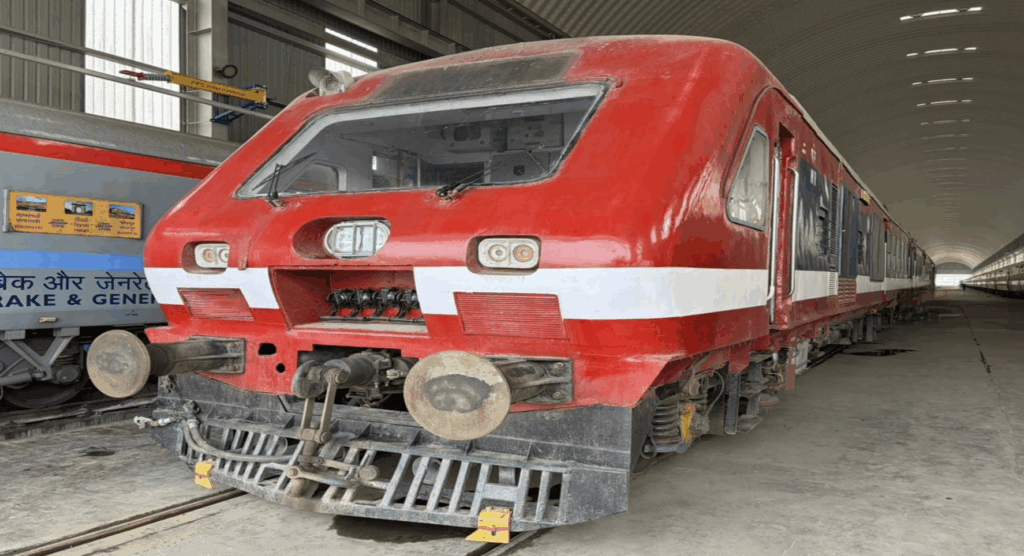
In a landmark move for sustainable rail transport, Indian Railways has launched the country’s first LNG-diesel dual-fuel Diesel Electric Multiple Unit (DEMU) train at the Sabarmati Integrated Coaching Depot in Ahmedabad. This development represents a major step toward reducing reliance on diesel, lowering emissions and cutting operating costs across rail services.
What Is the Dual-Fuel DEMU?
The newly operational train is a 1,400 HP DEMU whose driving power cars have been converted to run on a dual-fuel system — blending Liquefied Natural Gas (LNG) with traditional diesel. Under this system, LNG replaces approximately 40 per cent of diesel consumption, offering a cleaner alternative without compromising performance or reliability.
Two Driving Power Cars (DPCs) were retrofitted with LNG tanks and dual-fuel technology. These modified units successfully completed field trials covering over 2,000 kilometres, proving the feasibility and stability of the technology in regular passenger service. Railway officials report that the train has been operating smoothly without technical issues since being put into routine service.
Environmental and Economic Benefits
One of the primary motivations behind the LNG-diesel initiative is environmental sustainability. Using LNG significantly reduces harmful emissions such as carbon dioxide (CO₂) and nitrogen oxides (NOx) compared to diesel-only operation. This helps improve air quality along railway routes and contributes to broader national goals for cleaner transport.
In addition to environmental gains, the dual-fuel system offers economic advantages. With lower fuel costs associated with LNG, railways are expected to see substantial savings. Initial estimates suggest that each converted DPC could save roughly ₹11.9 lakh annually in fuel costs, rising to around ₹23.9 lakh per year for a full eight-coach DEMU rake equipped with two power cars.
The technology also allows automatic switching between diesel and LNG based on fuel availability, ensuring consistent performance even when LNG infrastructure is still being developed along routes.
Scaling Up: Future of Dual-Fuel Trains
The success of the Ahmedabad dual-fuel DEMU paves the way for wider adoption of alternative fuels in Indian Railways. Officials plan to convert additional DEMU power cars to LNG-diesel systems after completing mandatory emission tests and regulatory approvals. This could lead to broader deployment across non-electrified routes, reducing diesel use and supporting India’s transition to cleaner energy sources.
By integrating LNG into rail operations, Indian Railways continues to innovate in cleaner propulsion technologies — a critical priority as the country seeks sustainable transportation solutions that balance environmental goals with operational efficiency.