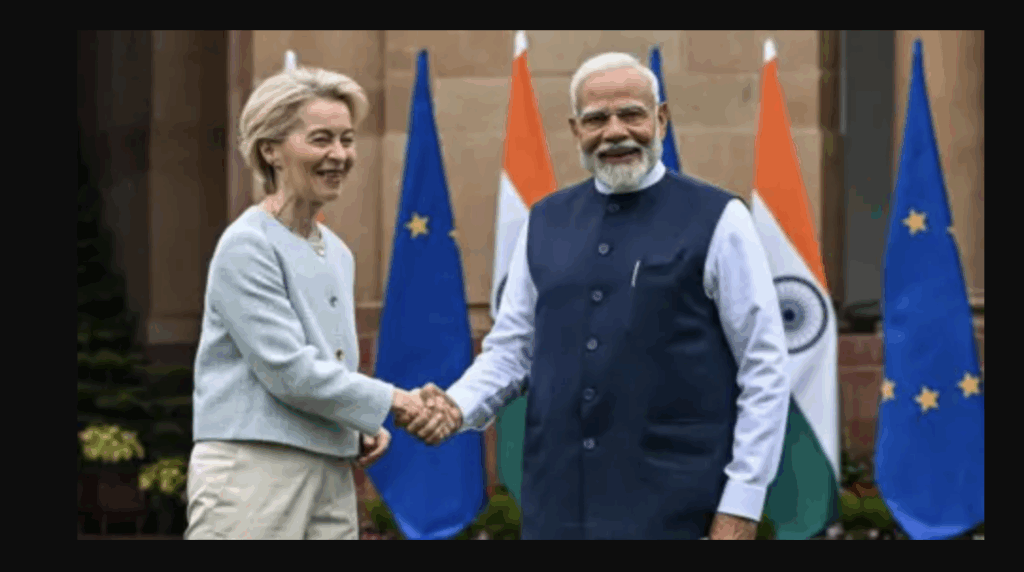
India and the European Union (EU) are close to finalising a long-awaited Free Trade Agreement (FTA) that could reshape bilateral trade and economic relations between India and the 27-member bloc. The deal — one of India’s most significant trade negotiations in years — aims to eliminate or reduce tariffs, boost exports, deepen investment ties and diversify markets amid global trade uncertainties.
Why The FTA Is Important
The EU is one of India’s largest trading partners, accounting for a major share of goods and services exchanged annually. The FTA is expected to:
- Expand market access for Indian exports by lowering or eliminating tariffs on goods and services shipped to the EU.
- Enhance foreign direct investment (FDI) flows in both directions by creating a more predictable business environment.
- Diversify export destinations, reducing over-dependence on limited markets and countering trade barriers such as high tariffs in other regions.
- Strengthen economic ties with a rules-based trading partner, fostering deeper integration in global supply chains.
The agreement is being viewed not just as a trade deal but as a strategic partnership driver that can complement India’s broader economic and geopolitical outreach.
Key Sectors That Could Benefit
The India-EU FTA is expected to benefit several sectors on both sides:
1. Textiles, Apparel and Leather
Indian garments and textile products — including leather exports — could gain from reduced EU tariffs, making them more competitive in European markets.
2. Pharmaceuticals and Chemicals
India’s pharmaceutical industry, especially generic drugs, may see improved access to European markets with streamlined regulatory recognition and lower trade barriers. Chemicals and organic products could also benefit.
3. Information Technology and Services
IT and business services are expected to gain from easier cross-border engagement, opportunities in digital trade and enhanced mobility for specialised professionals.
4. Engineering Goods, Automobiles and Electronics
Machinery, auto parts, electronics and other engineered products could see tariff concessions that improve India’s export footprint in Europe. These sectors already form part of expanding trade flows.
5. Agriculture and Processed Foods
Agri-exports and processed foods are anticipated to benefit through tariff reductions, expanding the reach of Indian food products in European markets, although sensitivities around EU agriculture standards will need careful negotiation.
Broader Economic Impacts
In addition to goods, the FTA is expected to enhance services trade, investment cooperation, and regulatory alignment in areas such as intellectual property, digital trade and green technologies. Increased FDI from European firms into Indian manufacturing, renewable energy, infrastructure and tech sectors could help modernise domestic capabilities.
However, like all comprehensive trade deals, there will be challenges around aligning regulatory standards, protecting sensitive sectors and ensuring that smaller domestic industries can compete effectively post-liberalisation.
A Milestone In India’s Trade Strategy
After years of negotiations, the India-EU FTA could become India’s 19th trade pact, symbolising a major shift toward deeper economic integration with one of the world’s largest markets. If successfully concluded, it will not only boost bilateral trade but also strengthen geopolitical and economic cooperation across multiple sectors.