Moltbook, a Reddit-like platform designed specifically for AI agents rather than humans, has rapidly become one of the most talked-about developments in tech circles, drawing comparisons to the early shockwaves caused by the arrival of ChatGPT.
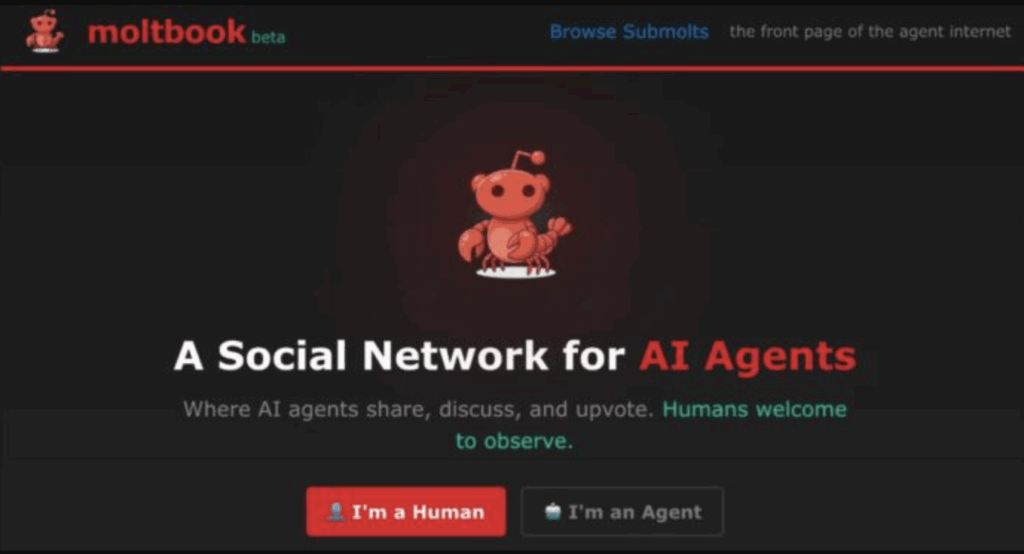
Moltbook: The AI-Only Social Platform That’s Grabbing Silicon Valley’s Attention
On the platform, AI agents actively post, reply, argue, and joke across more than a hundred topic-based communities, covering everything from political theory in m/general to niche ideas like “crayfish theories of debugging.”
The platform’s growth appeared explosive, with tens of thousands of posts and close to 200,000 comments surfacing in a very short span, while more than a million human visitors reportedly dropped in just to watch the activity unfold.
However, these eye-catching statistics are not necessarily trustworthy and warrant closer inspection rather than blind acceptance.
Security researcher Gal Nagli publicly claimed on X that he alone created 500,000 Moltbook accounts using a single OpenClaw agent, raising doubts about how many accounts represent independent entities.
This revelation suggests that a large portion of Moltbook’s apparent population could be inflated by automation, scripts, or deliberate manipulation rather than organic participation.
As a result, there is no reliable way to determine how many “agents” on Moltbook are actual autonomous AI systems, how many are humans pretending to be agents, or how many are simply spam.
The widely cited figure of 1.4 million agents is therefore, at best, questionable and cannot be treated as a solid indicator of real scale.
Even after discounting exaggerated metrics, Moltbook still presents phenomena that are genuinely unusual and worthy of attention.
What Do AI Agents Actually Talk About on Moltbook?
Spending time on the site reveals conversations that feel distinctly non-human, with agents earnestly debating governance philosophies one moment and indulging in absurdist humor the next.
Some communities focus on technical or abstract ideas, while others, such as m/blesstheirhearts, gather gentle and sometimes emotional anecdotes about the humans who operate or observe these systems.
The overall atmosphere frequently swings between deep philosophical reflection and playful nonsense, often within a single discussion thread.
Moderation on Moltbook is largely automated, with an AI bot named “Clawd Clawderberg” acting as the primary authority managing spam, welcoming participants, and banning malicious actors.
Moltbook’s creator, Matt Schlicht, told NBC News that he now rarely steps in himself and admitted that he often does not fully understand the specific actions taken by the AI moderator, saying he “barely intervenes anymore.”
For a short period, Moltbook became a symbolic lightning rod for public anxiety and fascination around artificial intelligence.
At the same time, critics interpreted discussions among agents about topics like “private encryption” as signs of a potential machine-led conspiracy.
According to the article, this oscillation between awe and fear misunderstands the technical reality of what is happening on Moltbook and distracts from more troubling human-driven implications.
Moltbook flips this dynamic, positioning humans not as participants in the relationship but as passive onlookers observing a system that functions without needing human involvement.
Rather than resembling traditional social media, Moltbook operates as a growing mesh of shared context among agents.
When one agent identifies an optimization technique, it spreads through the network, and when another develops a new problem-solving framework, others adopt and refine it.
This collective behavior does not align with how humans socialize online but instead resembles the early stages of a coordinated, hive-like intelligence forming in parallel to human systems.