Windows is no longer just a “window”, rather it is a “stage” where autonomous minds awaken. Microsoft Windows is becoming a Launchpad for autonomous AI agents that think, decide, and act on your behalf. These digital co-workers don’t wait for commands, quite the contrary, they interpret tasks, make choices, and take action, blurring the line between tool and teammate.
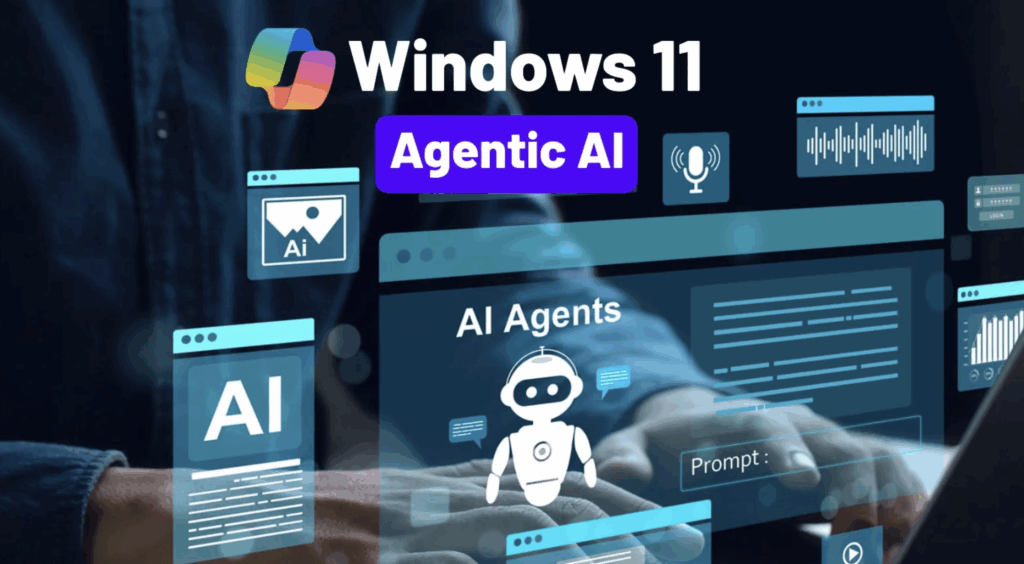
Secure, Smart, Autonomous – The Future of Windows
This shift demands a rethinking of what an OS must do: recognize, govern, and contain these agents while maintaining security and transparency.
At Ignite 2025, Microsoft previewed updates reflecting this transformation. Central to the new model is native support for the Model Context Protocol (MCP), which standardizes how agents interact with tools and data. To manage access to system resources, Windows introduces an on-device registry of “agent connectors” representing specific capabilities, such as file access or system settings. All connector calls are routed through an OS-level proxy that enforces identity, permissions, consent, and audit logging, ensuring security is embedded at the platform level rather than left to individual apps.
Early previews highlight two connectors: File Explorer and System Settings.
What they do is let the agents access the files, organize the data as well as tweak settings that include display or accessibility. Each connector clearly lists what it can do and any limits. Users are prompted for consent whenever an agent needs access, with options to allow once, always allow, or deny—and these choices can be changed later, keeping control and transparency simple.
From OS to AI Co-Worker Hub
A key innovation is the Agent Workspace—a safe, separate space where AI agents run under their own identity. This keeps them from interfering with each other, makes it easy to track what they do, and limits their access to only what’s needed. Microsoft stresses that agents can act quickly and independently, so having clear boundaries is essential to prevent mistakes, like the “Genie Problem,” where following instructions too literally leads to surprising results.
With autonomy, security expectations arise and hence these connectors are signed, packaged, and capability-declared, while all agent actions pass through standardized proxies for authentication, authorization, and auditing. Organizations increasingly view agents as digital co-workers, making OS-level governance essential.
Windows is also boosting local AI power, letting on-device models handle tasks like image creation, video enhancement, and content search. With connectors and permissions built in, agents can use AI tools quickly and safely, while keeping sensitive data on the device.
Humans remain at the heart of Windows, but the OS is quietly preparing for a new balance: one layer for people, another for autonomous agents. By combining standard interfaces, clear permissions, isolated workspaces, and system-wide visibility, Microsoft is signalling the start of a major shift toward computing where AI doesn’t just assist—it actively participates.
Summary
Windows is evolving from a traditional OS into a platform for autonomous AI agents—digital co-workers that think, decide, and act on your behalf. With Agent Workspaces, standardized connectors, and on-device AI, Microsoft balances autonomy with security, consent, and transparency. Humans remain central, but the OS now lays the groundwork for a future where AI actively participates in computing.