The government has brought guidelines by offering upto 100% subsidies for vehicle charging stations, battery swapping stations and battery charging stations in order to accelerate the adoption of electric vehicles.
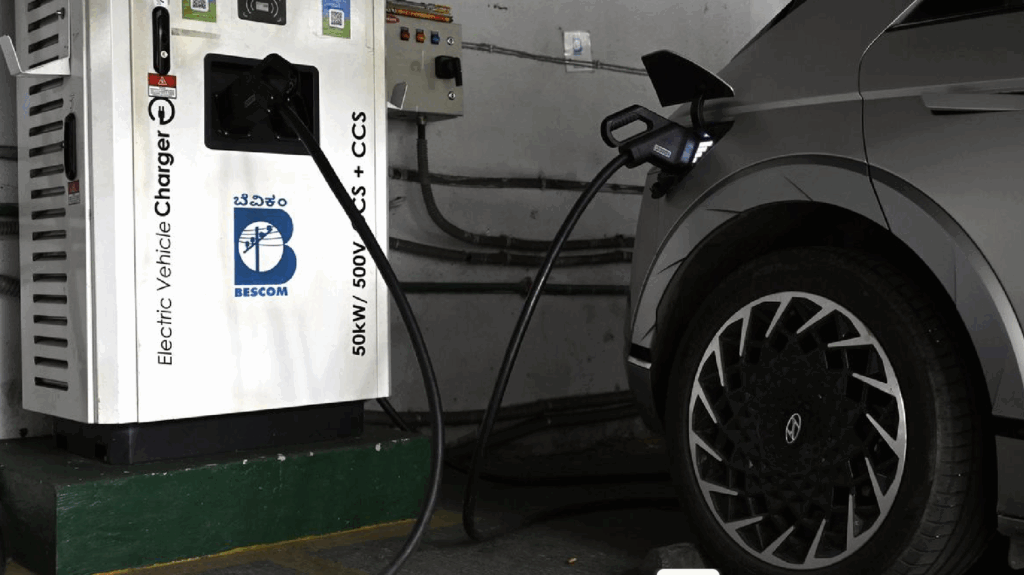
Government Declaring 100% Subsidies For EV Charging
Basically these guidelines are part of the ₹10,000 crore PM E-drive scheme for promotion of electric vehicles in the country out of which ₹2,000 crore has been apportioned for charging infrastructure.
These guidelines were released late on Sunday (September 28, 2025) evening.
Further, these guidelines mainly identify entities that are eligible for subsidies and offer support for deployment of upstream infrastructure costs, and in certain cases, also for EV Supply Equipment (EVSE) costs.
When it comes to the upstream infrastructure, it includes distribution transformers, low- and high-tension cables, distribution boxes, circuit breakers/isolators, mounting structures, fencing, and civil works.
The above mentioned EVSE consists of EV chargers including charging guns.
This latest scheme guidelines suggest that the ministries of the Government of India, Central Public Sector Enterprises (CPSEs), States and Union Territories, and public sector undertakings (PSUs) under them are eligible to submit proposals to the Ministry of Heavy Industries (MHI).
Moving ahead, these entities need to appoint nodal agencies to aggregate demand and identify suitable locations for charging stations before forwarding proposals to the ministry.
These entities may set up, operate, and maintain EV charging stations directly or they can engage Charge Point Operators (CPOs) for doing the same.
Who Can Participate?
In this regard, the country’s key central ministries including Petroleum & Natural Gas, Road Transport & Highways, Health & Family Welfare, Power, Housing & Urban Affairs, Railways, Civil Aviation, Steel, and Ports, Shipping & Waterways can put forward proposals through their CPSEs or appointed nodal agencies.
Besides those, countries public sector companies and bodies such as Indian Oil Corporation Ltd. (IOCL), Bharat Petroleum Corporation Ltd. (BPCL), Hindustan Petroleum Corporation Ltd. (HPCL), National Highways Authority of India (NHAI), Airports Authority of India (AAI), Steel Authority of India (SAIL), Container Corporation of India (CONCOR), Convergence Energy Services Ltd (CESL), and metro rail corporations can also apply either directly or through their parent ministries.
Further, they are expected to coordinate within their networks to map demand and finalise installation sites for the charging infrastructure.
In this case, States and Union Territories will perform a similar role of designating nodal agencies to aggregate demand.
Under the government’s PM E-DRIVE scheme, they will prioritise the installation of electric vehicle charging stations in cities with a population exceeding one million as per the 2011 census.
Moving ahead smart cities as notified by the Ministry of Housing and Urban Affairs (MoHUA), and satellite towns connected to the seven major metros — Delhi, Mumbai, Kolkata, Chennai, Hyderabad, Bangalore, and Ahmedabad.