Sundar Pichai recently suggested that Google may eventually run AI processing hardware in space, which sounded futuristic but was presented as a practical response to rapidly growing AI computing needs.
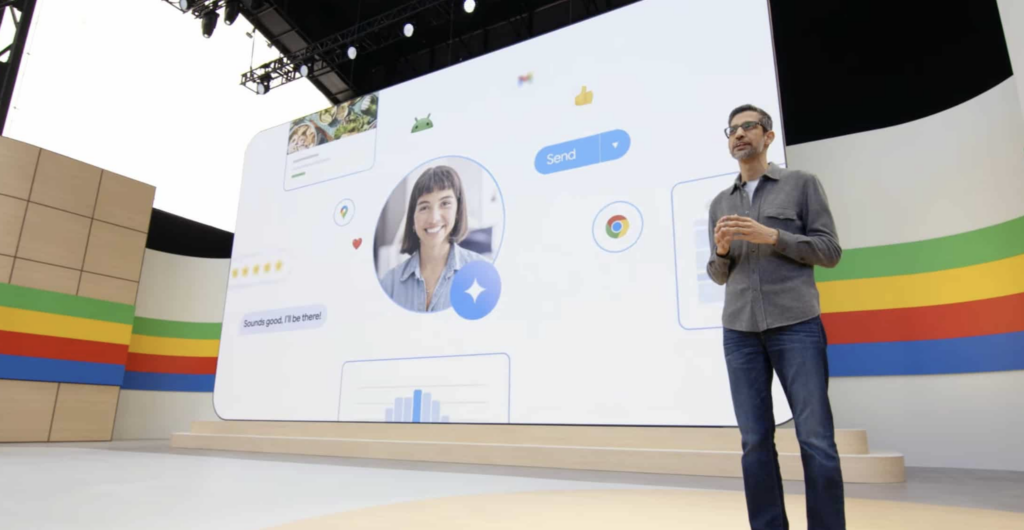
In a discussion with Google DeepMind’s Logan Kilpatrick, he said that the scale and speed of AI development could push the company to look beyond Earth because traditional data centers may not be able to keep up forever.
Google’s Next Frontier: Sundar Pichai Hints at AI Hardware Operating in Space
He explained that Google has massively expanded its computing power to support newer AI models like Gemini 3 and Nano Banana Pro, which required major upgrades in GPUs, TPUs, and data center capacity.
Pichai mentioned that there was a point when Google didn’t have enough computing resources, and responding to the rise of generative AI forced the company to accelerate investment in large-scale infrastructure.
This challenge is part of what pushed Google toward the idea of space-based computing, which could become a reality sooner than expected.
He said that by around 2027, Google may launch its first orbiting AI processors (TPUs), describing it as the beginning of a long-term shift in how computing infrastructure will evolve.
According to him, operating hardware in space offers clear benefits like unlimited solar energy, naturally lower temperatures, and no land constraints.
For regular users, this could simply mean faster, more reliable, and more powerful AI tools that remain stable even under heavy usage.
Pichai shared that the world is heading toward a future where AI is integrated into nearly every part of life—from search and video platforms to medical tools, research, and daily tasks—putting massive pressure on existing computing facilities.
He said the idea may seem unusual now, but once people imagine the scale of computing the world will need, the concept of orbiting hardware becomes more logical.
He compared this idea to earlier Google decisions that once looked unrealistic—like switching to an “AI-first” company model in 2016, building custom chips, creating Google Cloud, or developing self-driving cars—which are now core pillars of the company.
He joked that if Google launches chips into orbit, they might even pass Elon Musk’s Tesla Roadster floating in space, a reference meant humorously but backed by serious intent.
Project Suncatcher: Google’s Bold Move to Secure the Future of Computing Power in Space
He emphasized that computing power is becoming the main competitive edge in tech, and Google does not plan to run out of room or capacity.
He revealed that Google has already begun exploring this direction through an initiative called Project Suncatcher, which studies how computing systems might function outside Earth.
While full-scale space data centers may still be far off, the first orbiting chips would act as proof that the next era of computing has started.
If Google succeeds, it could transform how AI is powered and distributed, lower the environmental strain of massive land-based data centers, and open new debates about governance, ownership, and cybersecurity in space.
For everyday people, this shift could lead to AI that is faster, more powerful, and available without overwhelming the planet’s infrastructure.