Like a city chasing clean skies on borrowed breath, Delhi stands at a crossroads between ambition and infrastructure.
Charging Ahead or Running on Empty?
As Delhi sprints toward its 2026 clean air targets, electric mobility has become its boldest wager. The Delhi Action Plan and the NCR Plan for 2026, submitted to the Commission for Air Quality Management (CAQM), aim to cut the capital’s annual AQI by at least 15% by pushing electric vehicles (EVs) and expanding battery electric bus fleets.
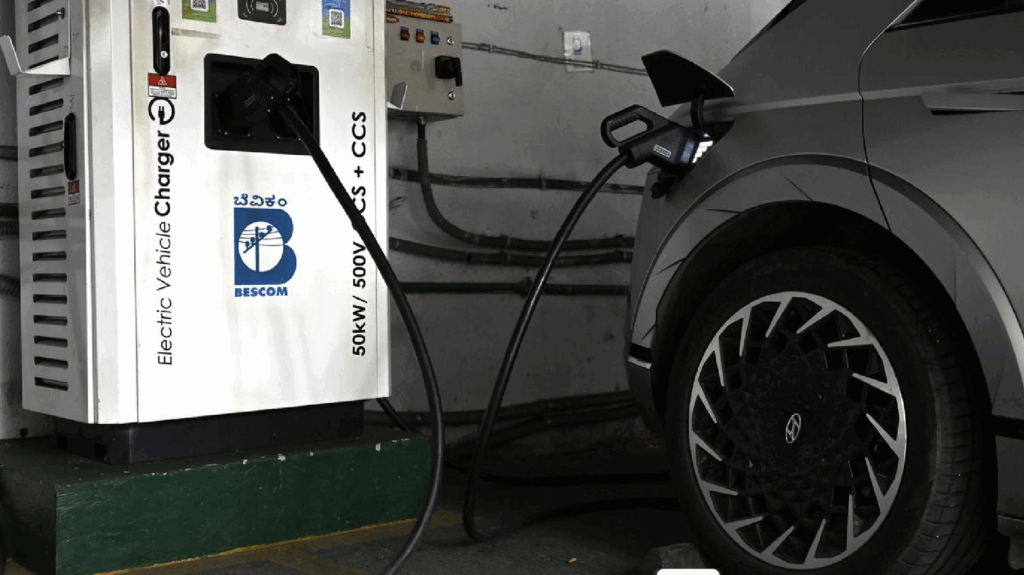
Vehicular emissions remain one of Delhi’s most persistent pollution sources, and EV adoption is framed as a decisive remedy. Yet a pressing question lingers: is the city building sufficient charging infrastructure to sustain this transition?
Under the CAQM 2026 roadmap, Delhi-NCR has assessed its existing charging points, projected requirements, and city-specific targets. The imbalance is stark. Delhi currently operates only about one-fourth of the charging stations it needs. Even if it meets its 2026 goal, over half the required network will remain unmet — a shortfall that could discourage private buyers who depend on reliable charging access.
Ghaziabad faces similar constraints. Even upon achieving its target, it would reach only about half of its estimated requirement, casting doubt on convenient EV usage for commuters. In contrast, Noida and Sonipat appear comparatively better positioned due to more manageable targets. Gurgaon and Faridabad have modest ambitions, each aiming for just 20 charging points.
A National Surge, A Structural Strain
Delhi’s gaps mirror a broader national pattern. As of December 16, 2025, the Ministry of Heavy Industries reports that 29,151 EV charging stations were installed across India in the past five years — including 8,805 fast chargers and 20,346 slow chargers.
Yet distribution remains uneven. Karnataka and Maharashtra lead with dense networks, supported by robust policies, strong manufacturing bases, and high urban demand. Uttar Pradesh, Tamil Nadu, and Rajasthan are progressing, while many states lag. Hill states show slower adoption, largely due to concerns about EV reliability in challenging terrain.
Meanwhile, EV sales are accelerating across segments. Passenger EV sales have nearly doubled within a year. Three-wheelers and commercial fleets continue steady growth, fueled by cost efficiency and last-mile logistics demand. Two-wheelers dominate volumes, forming the backbone of India’s electric shift. Rising sales reflect growing acceptance — but also intensify pressure on charging systems.
Policy signals appear supportive. The PM E-Drive scheme has secured higher funding for 2025-26, rising further to Rs 1,500 crore in 2026-27. The PM e-Bus Sewa programme saw funding jump from nearly Rs 5 crore in FY25 to Rs 510 crore in FY26, though it declined to Rs 12 crore in the current year.
Delhi’s clean air dream now hinges not just on vehicles sold, but on plugs installed.
In the race toward electric dawn, ambition must be wired to reality before the lights can truly stay on.
Summary
Delhi’s 2026 clean air plan hinges on electric mobility, targeting a 15% AQI reduction. However, charging infrastructure lags far behind projected demand, with major gaps in Delhi and Ghaziabad. Nationally, EV adoption is rising rapidly, supported by increased government funding, but uneven charging networks threaten to slow momentum and challenge large-scale transition efforts.