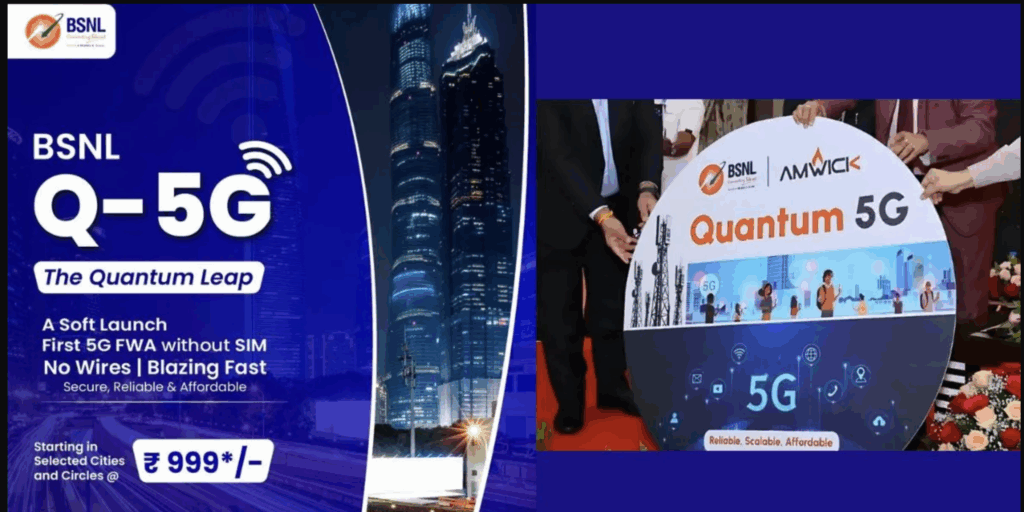
State-owned telecom operator BSNL has rolled out its Quantum 5G (Q-5G) internet service, offering high-speed mobile broadband without the need for a traditional SIM card or wired connection. The new service aims to bring reliable 5G connectivity to homes and small businesses with simple plug-and-play hardware and affordable monthly plans, marking a major push in India’s digital inclusion efforts.
What Is SIM-Free 5G Internet?
Unlike conventional 5G services that require a SIM card, BSNL’s Quantum 5G uses fixed wireless access (FWA) technology. This means users only need to install a compatible router or device that connects wirelessly to nearby 5G towers — no SIM or physical wiring required. The hardware provides a broadband-like experience through radio signals, enabling fast internet with minimal installation complexity.
Affordable Plans to Reach More Users
At launch, the service includes a 100 Mbps plan priced around ₹999 per month, making it one of the most cost-effective 5G internet options in the market. There’s also a higher-speed option — typically offering up to 300 Mbps for around ₹1499 per month — catering to users with heavier data needs such as streaming, remote work, or online gaming.
Because the service doesn’t depend on fibre cables or SIM cards, users can begin using ultra-fast 5G internet simply by plugging in the router and powering up. This makes it especially useful in areas where fibre broadband penetration is limited.
India TV News
Where It’s Being Deployed
Early rollouts of BSNL’s SIM-free 5G service are taking place in major cities including Hyderabad, Pune, and several other urban and semi-urban centres. Plans are underway to expand availability to additional regions over time, increasing access across the country and helping bridge connectivity gaps in underserved areas.
A Boost for Digital Access
The introduction of plug-and-play 5G broadband is seen as a strategic move by BSNL to compete with private telecom providers while supporting India’s broader digital goals. By offering affordable, high-speed internet with minimal setup, the service has strong appeal for households, small businesses, and educational uses. It also positions BSNL as a challenger in the evolving broadband landscape, especially in markets where laying fibre infrastructure is difficult or expensive.
What This Means for Users
For consumers, the biggest advantages are simplicity and value — high-speed internet with no SIM, no cables, and quick activation. For rural and suburban users, this could be a practical alternative to traditional broadband. As connectivity becomes increasingly critical for everything from education to entertainment and remote work, affordable 5G access can support socioeconomic growth across India.