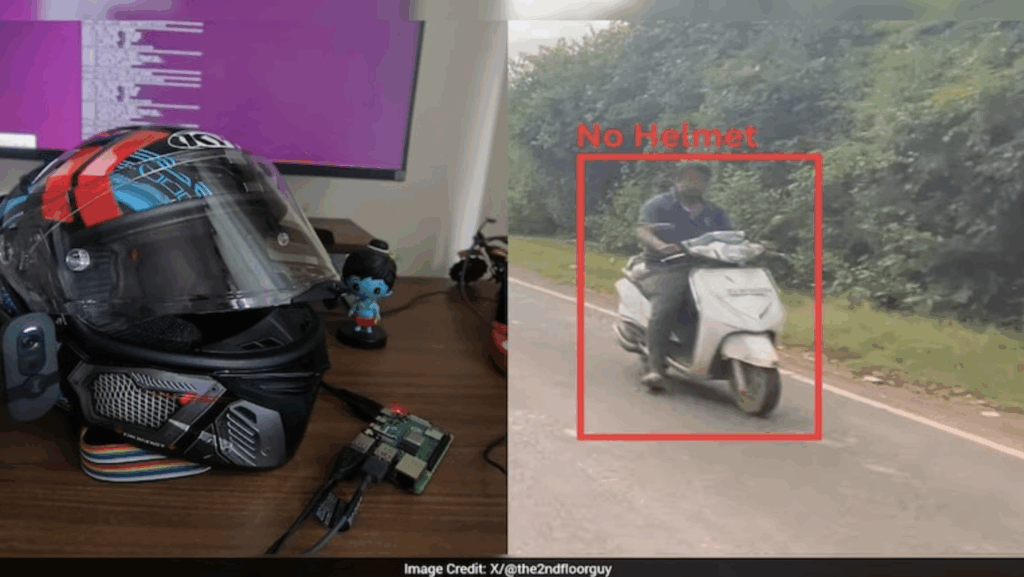
A resident of Bengaluru has developed an ingenious AI-powered helmet gadget that assists traffic enforcement by detecting and flagging traffic violations in real time. Combining wearable tech with artificial intelligence, this DIY innovation reflects growing interest in using smart tools to improve road safety and aid law enforcement on India’s busy streets.
What the AI Helmet Does
The device is essentially a helmet rigged with AI-driven cameras and sensors mounted to assist a traffic officer. As the wearer moves through traffic — especially at congested intersections — the system:
- Automatically detects traffic violations such as red-light crossing, wrong-way riding, helmetless riders and other unsafe behaviour
- Alerts the wearer instantly when a violation is spotted
- Can potentially record evidence that may be used for enforcement or reporting
This smart setup uses machine vision and pattern recognition to identify vehicles and traffic rule breaches without human lag, making it a compelling example of real-time enforcement technology.
How It Works
The innovation leverages computer vision software trained to recognise common traffic violations. A camera mounted on the helmet feeds live video to an onboard processor or connected device running the AI model, which scans the traffic scene continuously. When a violation is detected, the system can flag it via audio alerts or on-screen indicators visible to the rider or officer.
Though it remains a garage-style prototype, the concept demonstrates how wearable AI could complement existing traffic systems rather than replace them outright.
Why It Matters for Bengaluru Traffic
Bengaluru — like many major Indian cities — experiences heavy congestion and frequent road mishaps. Traffic enforcers often struggle to monitor violations in real time due to manpower and visibility constraints. An AI assistant on a helmet could help:
- Spot violations that might otherwise go unseen
- Supplement manual enforcement efforts
- Improve accountability for unsafe driving
- Enhance evidence capture for later action
If refined and scaled, such technology could assist traffic police or authorised road safety volunteers in managing busy junctions.
Citizen Innovation and Practical Challenges
The helmet innovation is a striking example of grassroots tech ingenuity, showing how individuals can build tools that tackle real-world problems. However, several practical questions remain before such devices can be widely deployed:
- Accuracy and reliability of AI detection in diverse lighting and weather conditions
- Legal and ethical considerations around automated violation reporting
- Integration with official enforcement systems and fine-collection mechanisms
- Data privacy, storage, and misuse prevention
These hurdles mean that while the prototype is impressive, broader adoption requires collaboration between innovators, government agencies, and tech developers.
Conclusion
The AI-powered helmet conceived in Bengaluru showcases how smart technology can be adapted to aid traffic monitoring and enhance safety. While still a prototype, it underscores the potential for wearable AI to support enforcement in busy urban environments, provided accuracy, legality, and integration challenges are addressed before wider use.