In a surprising discovery, Air India recently identified a Boeing 737 that had been missing from its records for more than a decade. The jet—registered as VT-EHH—was found abandoned at Kolkata Airport (CCU), where it had been parked since 2012 without proper documentation, oversight, or tracking.
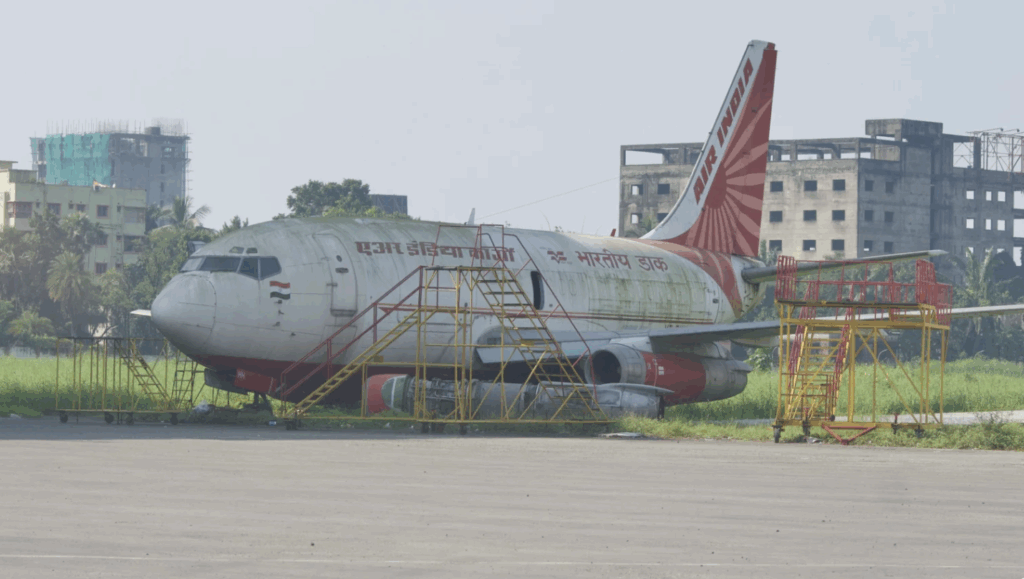
Kolkata Airport authorities initiated the discovery after requesting Air India to remove the long-forgotten aircraft.
A 43-Year-Old Jet Lost in Paperwork
VT-EHH, a Boeing 737-2A8F from the iconic “Baby Boeing” family, began its life with Indian Airlines in 1982. It later flew with Alliance Air and was finally converted into a freighter for India Post in 2007.
Despite its decades-long service, the aircraft slipped through the cracks of Air India’s outdated asset management systems.
Key documents—such as depreciation records, insurance details, maintenance schedules, and financial registers—had no trace of the aircraft.
This oversight persisted across multiple administrations leading up to Air India’s privatization.
How Does an Entire Airplane Go Missing?
Before the Tata Group acquired Air India, the state-run carrier struggled with inconsistent record-keeping and fragmented asset registers.
Aviation insiders say:
- Fixed-asset tracking was poor
- Maintenance and insurance logs were outdated
- Data validation practices were weak
- Legacy systems were never reconciled properly
Air India CEO Campbell Wilson confirmed that VT-EHH had been left out of internal documentation repeatedly, meaning it didn’t contribute to the airline’s valuation at the time of privatization.
A Tale of Two Old Airplanes
Historical accounts reveal that VT-EHH was stored alongside another classic aircraft, VT-EGG, at Kolkata.
While VT-EGG was later moved to Rajasthan to become a restaurant attraction, VT-EHH remained forgotten at CCU.
Some aviation watchers even spotted VT-EHH earlier in Delhi before it ultimately ended up being sold, with the buyer and sale price undisclosed.
A Wake-Up Call for Modernization
The rediscovery underscores why modern aviation operations require airtight governance, digital documentation, and real-time asset tracking.
Since taking over, the Tata Group has focused on:
- Overhauling IT systems
- Cleaning up old leases
- Renegotiating vendor contracts
- Standardizing asset registers
- Fixing HR and maintenance gaps
These reforms aim to bring Air India up to global standards and prevent future administrative lapses.